
Ambraee Houslin | The Bank in Your Pocket: AI, Fintech, and the Unbundling of Caribbean Banking


For most Jamaicans, the banking relationship has always been a slightly uncomfortable one. Long queues. Opaque fees. Loan applications that feel like auditions for a role you were never going to get. A savings rate that barely keeps pace with inflation. And a branch that closes at 3:00 p.m., precisely when most working people are still at their desk.
That relationship is now being renegotiated. Not by regulators, not by a formal policy agenda, but by technology. Quietly, and with increasing speed, artificial intelligence and financial technology are pulling apart the traditional bank and offering its individual components to anyone with a smartphone.
The question for the Caribbean is not whether this unbundling will arrive. It already has. The question is who will be holding the pieces when the dust settles.
What Unbundling Actually Means
The traditional commercial bank is, at its core, a bundle of services: deposit-taking, payments, lending, foreign exchange, wealth management, and insurance distribution, all wrapped inside one institution. For most of the twentieth century, this bundling made sense. It was expensive to build the infrastructure for any one of these services individually, and consumers had little alternative.
Fintech changed the economics. A payments startup does not need a vault or a teller window. A digital lender does not need a branch network. A robo-advisory platform does not need a relationship manager. Each piece of the bundle can now be built and delivered independently, often at a fraction of the cost and with a user experience that the traditional banks, weighed down by legacy systems and institutional inertia, struggle to match.
In the United States and United Kingdom, this process has been underway for more than a decade. Companies like Stripe, Chime, Revolut, and Robinhood have captured meaningful market share in payments, retail banking, and retail investing, respectively. The Caribbean has watched from a distance. That distance is now closing.
The Regional Landscape
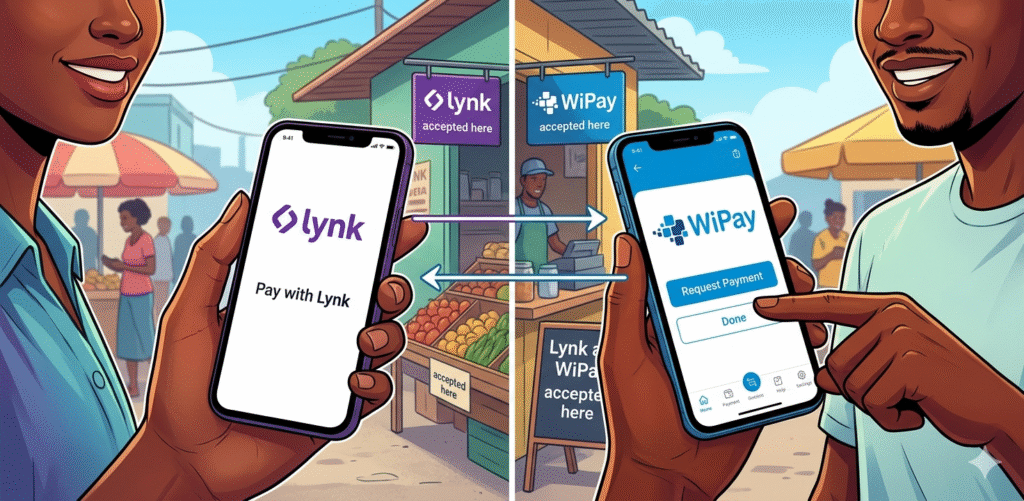
Across the Caribbean, a new cohort of fintech players has emerged. In Jamaica, the growth of WiPay, Lynk, and the wider mobile money ecosystem signals that the payments layer of banking is being actively contested. NCB’s Lynk platform, in particular, represents one of the more serious attempts by an incumbent bank to own its own disruption, building a digital wallet infrastructure that targets the unbanked and underbanked population that traditional banking has never adequately served.
Trinidad and Tobago has seen similar movement. Bitt, the Barbados-based fintech, gained regional attention for its work on central bank digital currency pilots, including the Eastern Caribbean Central Bank’s DCash project, which represented one of the earliest government-backed digital currency deployments in the world.
What is notable about these developments is not simply the technology itself, but the populations they reach. Across the Caribbean, a significant share of adults remain outside the formal banking system. In Jamaica, informal savings schemes like partner and box-hand have persisted precisely because formal institutions were too expensive, too inaccessible, or too indifferent to serve them. Fintech, at its best, addresses the same underlying need with better infrastructure.

Where AI Enters the Picture
If fintech unbundled the bank, artificial intelligence is now beginning to rebuild parts of it in ways that are more personalised, more efficient, and fundamentally more threatening to the existing order.
The most immediate application is credit decisioning. Traditional bank lending in the Caribbean relies heavily on formal income documentation, collateral, and credit history, criteria that systematically exclude self-employed individuals, small business owners, and workers in the informal economy. AI-driven credit models can incorporate a far wider range of data: transaction patterns, utility payment behaviour, mobile usage data, and even cash flow seasonality, to build a more accurate picture of creditworthiness for individuals who would have been denied under the old model.
This is not a theoretical development. Across Latin America, companies like Nubank in Brazil and Konfio in Mexico have already demonstrated that AI-powered credit can profitably serve market segments that traditional banks had written off. The same playbook is arriving in the Caribbean, and it will put pressure on local institutions to either adopt similar models or cede the market.
Beyond credit, AI is transforming customer interaction. Large language models now power conversational banking interfaces capable of handling complex customer queries, processing applications, and providing financial guidance without a human in the loop. For a region where bank branch coverage has always been uneven and customer service has been a persistent complaint, the implications are significant.

The Institutional Response
The incumbent banks are not standing still, but their responses vary widely. The larger regional players, NCB Financial Group, Sagicor Financial Corporation, and the Massy financial services operations, have each made investments in digital infrastructure and, to varying degrees, in fintech partnerships or acquisitions. This is broadly the right instinct. The financial institutions that will navigate this transition successfully are those that understand their core competitive advantage is not their technology stack, which can be replicated, but their regulatory standing, their balance sheet, and their existing customer relationships.
The smaller institutions face a harder challenge. Community banks and credit unions across the region carry the weight of legacy infrastructure and constrained capital budgets. For these organisations, the technology investment required to remain competitive is neither cheap nor optional. The risk of a gradual erosion of their deposit base and lending market to more nimble digital competitors is real and should be taken seriously by their boards.
Regulators, for their part, are in a difficult position. The Bank of Jamaica and its counterparts across CARICOM have a mandate to maintain financial stability, which implies caution. But excessive caution risks cementing the advantages of incumbents and slowing the adoption of technology that could genuinely expand financial inclusion. The regulatory sandbox approach, which BOJ has engaged with in limited form, is a productive framework. It needs to be extended and given greater institutional commitment.

What This Means for the Average Jamaican
For the person who has spent years being turned down for a small business loan, or who pays three per cent to cash a cheque, or who has a relative abroad sending remittances through a corridor that extracts an unconscionable fee, the unbundling of banking is genuinely good news.
The barriers to financial participation are falling. A young entrepreneur in Portmore who does not have a credit history can now, in principle, access working capital through a digital lender who evaluates her cash flow directly. A market vendor in Kingston can now accept card payments through a mobile point-of-sale device that costs nothing to acquire. A Jamaican in London can send money home through a digital transfer service that charges a fraction of what Western Union demanded a decade ago.
These are not incremental improvements. They represent a structural shift in who has access to financial tools and on what terms. That shift carries its own risks, including predatory lending dressed in a digital interface, data privacy concerns, and the displacement of workers in the financial services sector. These risks are real and deserve regulatory attention. But they do not outweigh the opportunity.
The Bigger Strategic Question
There is a larger question underneath all of this, one that Caribbean policymakers and capital markets participants should be asking more urgently. As the financial services industry is restructured by technology, will the region be a consumer of that restructuring or a participant in it?
The fintech infrastructure being built in the Caribbean today is largely imported. The platforms, the algorithms, the cloud infrastructure, and in many cases the capital, originate outside the region. This is not inherently a problem, but it does mean that the economic value created by this transition will, in large measure, flow outward unless deliberate efforts are made to build local capability.
There is an opportunity here for the JSE, for development finance institutions like the DBJ, and for the private capital community to orient capital toward homegrown fintech development. The talent exists. The market need is clear. What has historically been missing is the patient, risk-tolerant capital and the institutional framework to support early-stage financial technology ventures.
The unbundling of Caribbean banking is not a threat to be managed. It is a transition to be navigated, and the countries and institutions that approach it with clarity and ambition will be better positioned than those that treat it as a disruption to be minimised.
The bank in your pocket is coming. The only question worth asking now is who built it.
This commentary is published for informational purposes only and does not constitute investment advice.
Ambraee Houslin is a Private Equity Strategist with a strong background in economics and statistics. He has extensive experience in investment banking, corporate finance, and investment research across Jamaica and the Caribbean region. His core expertise includes mergers and acquisitions, capital structuring, and executing complex transactions that drive growth and value creation. Ambraee has led and supported deals spanning strategic acquisitions, private credit facilities, and post-transaction integration strategies for high-impact sectors.
Syndicated from Our Today · originally published .
Legal context · powered by Jurifi
Get the legal angle on this story. Pick a prompt and Jurifi's AI will explain it using Jamaican law.
AI replies are based on Jamaican law via Jurifi. Not legal advice.
Other coverage

Dr. Marlene Street Forrest: Financing For Success
Jamaica Stock Exchange (Video)Watch
Ronald Thwaites | The ‘rude boy’ mentality
Jamaica Gleaner
Guyana rolls out real-time payments and opens banking sector to new international players
Cnweekly
The Business Report—May 22, 2026
PBC Jamaica (Video)Watch
Angus Young: Broker Dealers - The Conduit For Businesses To Access Capital For Growth & Expansion
Jamaica Stock Exchange (Video)Watch