
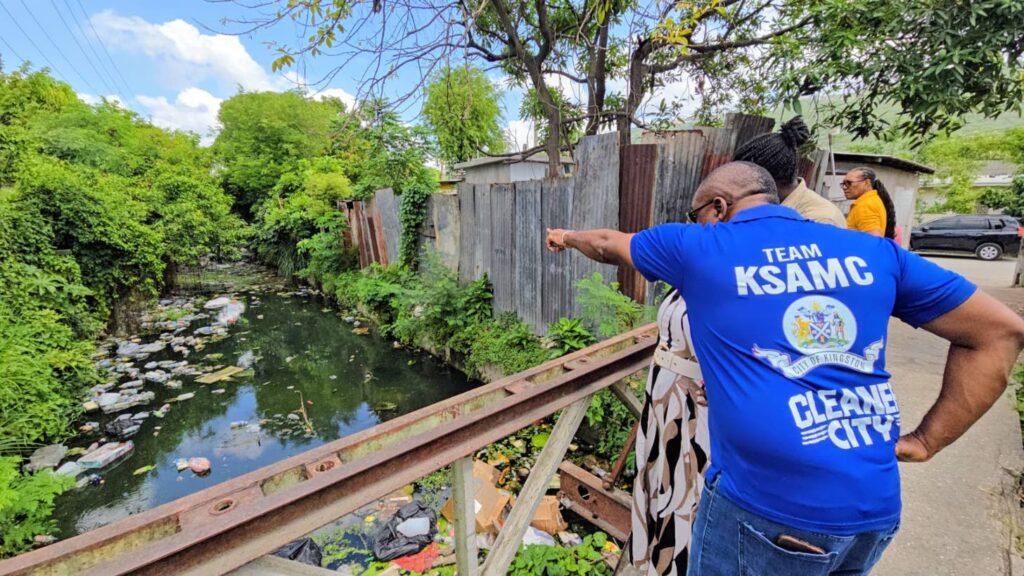
A $23-million sum that was budgeted for road rehabilitation in the Corporate Area by the Kingston and St Andrew Municipal Corporation (KSAMC) has been repurposed to clear choked drains and restore polluted coastlines in an effort to prevent flooding if the country faces heavy rain during the current hurricane season.
In making the announcement on Thursday, Mayor of Kingston Andrew Swaby warned that disposal of garbage is draining the municipality’s financial resources as the KSAMC started phase one of the drainage-cleaning project in preparation for the Atlantic hurricane season, which began on June 1 and ends on November 30.
While pointing to the importance of unclogged drains and clean coastlines, Swaby pointed out that poor waste management is costing the city a great deal of money to pick up after illegal dumpers.
“If we as citizens adhere to proper waste management in terms of how we dispose not only of our garbage, but just in general, our gravel and those things, it will certainly allow the KSAMC and other local authorities to spend less on cleaning drains and more on fixing our roads,” said Swaby.
He has before complained about the municipality’s strained budget, highlighting in May — during a KSAMC monthly meeting — that, on average, $85 million is allocated to its Parochial Revenue Fund, which is primarily for road maintenance, but is further split to accommodate drain cleaning, de-bushing, and support seasonal work programmes.
Plastic bottles, bags, and other garbage items are seen floating in the Duhaney River by Riverside Drive in St Andrew.
According to Swaby, after inspection of several coastlines and gullies in the Corporate Area, 27 drains across nine municipal divisions were identified as needing critical drain cleaning, amounting to a hefty $23 million in the first phase.
“As I would have indicated in my Statement and Announcements last month, the KSAMC, at the beginning of the Atlantic hurricane season, would clean drains in all divisions,” he said.
“The Technical Department has divided the drains in Kingston and St Andrew into two phases. There are the divisions that are considered critical drain cleaning, those are the coastal divisions, and it amounts to nine divisions. And what they have identified is 27 drains…after that we will do the remainder of divisions,” explained the mayor.
He noted that the communities closest to coastlines were being given first priority to prevent flooding due to blocked drains or littered coastlines in the case of heavy rains.
“These drains are in…the Duhaney Park Division, the Seaview Gardens Division, the Tivoli Gardens Division, the Greenwich Farm Division, and all those drains along that coastal line that goes right back up to Dallas. These are critical drains. These are drains that, obviously, if there’s a flooding, it will seriously impede traffic or flood communities,” said Swaby.
Debris in Kingston Gully
Meanwhile, acting chief engineering officer at the KSAMC Yekini Binnie placed construction companies in the hot seat for engaging in illegal dumping as he charged that both citizens and business owners are playing a part in the pollution problem.
“We have to, each year, clean these drains ahead of the hurricane period to ensure that the citizens and the traffic can flow properly in the case of heavy rain events. You see the garbage in the drains, you see the silt, you see the building materials, you see refrigerators, and you see mattresses in the drains. So one can only assume that it is as a result of…poor waste management habits of the citizenry and others. Construction companies are also dumping illegally. So there’s a lot to be done. It touches all sectors of the Jamaican public,” he said.
Appealing to residents, Swaby underscored that it is everyone’s duty to practice proper waste disposal as he pointed out that if the situation was improved, the city would save money and preserve its environment.
“I want to implore all the residents of Kingston and St Andrew that it is our responsibility also to make sure that we practise proper waste management. It cannot be a situation where you throw bottles into the gully. It should not be a situation where our debris from the gravel that we have to do our buildings is washed in these drains because after a time, even if it doesn’t affect us directly, there are other communities that it will certainly affect,” said Swaby.
Syndicated from Jamaica Observer · originally published .
Legal context · powered by Jurifi
Get the legal angle on this story. Pick a prompt and Jurifi's AI will explain it using Jamaican law.
AI replies are based on Jamaican law via Jurifi. Not legal advice.