
Dr. Paul A. Blake | Beyond Behaviour: Why adults must understand children before correcting them

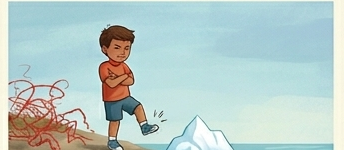
When a child repeatedly misbehaves, adults usually focus on stopping the behaviour. The child may be shouted at, punished, suspended, embarrassed, or labelled as disrespectful, lazy, aggressive, or difficult.
In some cases, consequences are necessary. Children need rules, boundaries, discipline, and accountability. However, adults must also recognise that behaviour does not occur in isolation. It may be connected to the child’s emotions, relationships, environment, development, or mental health.
Understanding the reason behind behaviour does not excuse wrongdoing. It helps adults respond in a way that corrects the behaviour while addressing the problem beneath it.
A child who is constantly angry may be experiencing fear, rejection, stress, or embarrassment. A child who refuses to complete schoolwork may be struggling academically and trying to avoid humiliation. A child who lies may be afraid of punishment or disappointing an adult. A child who becomes unusually quiet may be dealing with grief, bullying, family conflict, abuse, anxiety, or depression.
Adults often see the action without considering what may be driving it.
Behaviour Can Communicate a Need

Children do not always have the language or confidence to explain how they feel. Younger children may not understand their emotions well enough to describe them. Older children may remain silent because they fear punishment, rejection, disbelief, or embarrassment.
As a result, their behaviour may communicate what they cannot say directly.
This does not mean that every incident requires a psychological explanation. Children sometimes test limits, make poor choices, or behave irresponsibly. The adult’s responsibility is to determine what must be corrected and what may require additional support.
Before reacting, adults should ask several questions.
What happened before the behaviour?
Is this behaviour new or has it been happening for a long time?
Does it happen in one setting or across home, school, and church?
What emotion might the child be experiencing?
Does the child understand what is expected?
Does the child have the skills needed to respond differently?
Has something changed in the child’s family, school, friendships, health, or routine?
These questions allow adults to respond with greater accuracy rather than making assumptions.
Understanding the Four-Part Child Brain
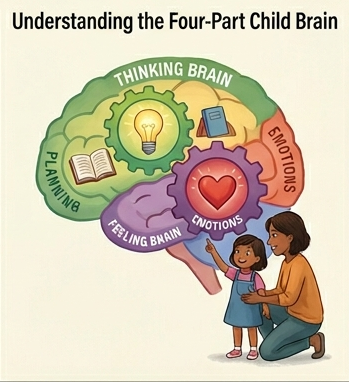
I developed the Four-Part Child Brain as a practical educational framework to help parents, teachers, church leaders, and caregivers understand some of the factors that influence children’s behaviour. To make this framework more accessible, it can be helpful to see how it applies at home in everyday situations. For example, when a child refuses to do homework, a parent might pause and ask which part of the brain could be most active: Is the child struggling to think clearly (Thinking Brain)? Is frustration or worry overwhelming them (Feeling Brain)? Are they reacting to stress or pressure as if it is a threat (Survival Brain)? Or do they need reassurance and connection before they can focus (Connection Brain)? Another common situation is when siblings argue. Instead of immediately disciplining, a parent can use the Four-Part Child Brain to first check if the child needs to feel emotionally safe or is acting out of a need for connection, before teaching them better ways to resolve conflict.
These small shifts in perspective can guide parents to respond more calmly and effectively.
It is not intended to be a medical diagnosis. It is a simple way of thinking about four important areas of a child’s development and response.
The Thinking Brain supports judgment, learning, planning, problem-solving, decision-making, and impulse control. When children are calm, they are generally better able to listen, reflect, and understand consequences.
The Feeling Brain is connected to emotions such as fear, sadness, anger, joy, frustration, shame, and loneliness. Children may experience strong emotions without knowing how to identify or manage them.
The Survival Brain responds when a child feels unsafe, threatened, trapped, or overwhelmed. This response may appear as fighting, running away, freezing, crying, screaming, aggression, or shutting down.
The Connection Brain relates to trust, love, attachment, belonging, and reassurance. Children need stable relationships with adults who are consistent, caring, and emotionally available.
When a child is highly distressed, the Feeling Brain or Survival Brain may dominate the response. In that moment, the child may struggle to listen, reason, or explain what happened. A long lecture or public confrontation may make the situation worse.
Adults should first make sure everyone is safe, help the child become calm, and address the behaviour when the child is able to participate in the conversation.
Discipline Must Teach
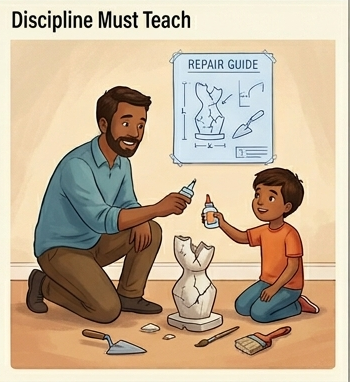
Discipline should help children understand what they did wrong, why it was wrong, what they should do differently, and how they can repair the harm caused.
Punishment alone may stop behaviour temporarily, but it does not always teach the skill the child needs.
For example, telling a child to stop being disrespectful does not necessarily teach the child how to disagree appropriately. Taking away a device may be reasonable, but the child may still need to learn how to manage disappointment, communicate frustration, and accept a decision.
Healthy discipline should include clear expectations, fair consequences, explanation, practice, and follow-up.
Adults should also avoid attacking the child’s identity.
There is a difference between saying, “You told a lie,” and saying, “You are a liar.”
The first statement identifies an action that must be corrected. The second labels the child and may contribute to shame or resentment.
Adults can be firm without humiliating children. They can hold boundaries without withdrawing love. They can apply consequences without making children feel worthless.
Children Need Different Forms of Safety
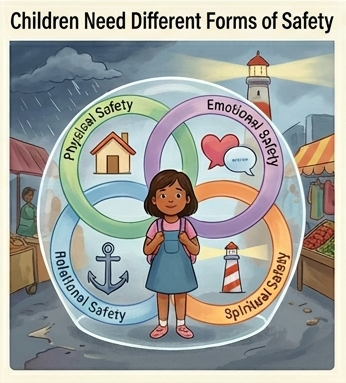
Safety is not limited to protection from physical harm.
Children also need emotional, psychological, relational, and spiritual safety.
Physical safety includes protection from abuse, neglect, bullying, violence, unsafe adults, and harmful online activity.
Emotional safety means children can express fear, sadness, confusion, or anger without being mocked or dismissed.
Psychological safety means children are not constantly threatened, compared, humiliated, or made to feel that they are a failure.
Relational safety means children know that the adults responsible for them will remain present, even when correction is necessary.
Spiritual safety means faith is used to provide guidance, hope, values, and purpose, not to silence children or frighten them into submission.
Children must also be taught basic body-safety principles. They should know that their bodies belong to them, that adults should not ask them to keep unsafe secrets, and that they should report situations that make them uncomfortable.
When a child reports abuse or unsafe behaviour, adults must respond responsibly. The position, reputation, family connection, or religious status of the accused person must never be placed above the safety of the child.
Adults Must Notice Changes
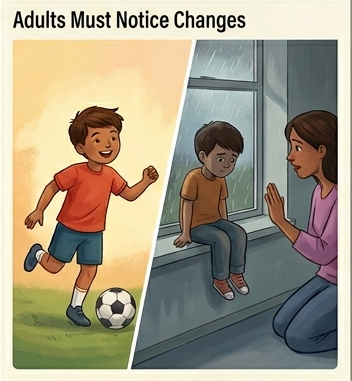
Many children struggle for long periods before an adult recognises that something is wrong.
Parents, teachers, and church leaders should pay attention to sudden or significant changes in behaviour.
These changes may include withdrawal, persistent anger, frequent crying, sleep problems, declining grades, loss of interest, unusual fear, changes in appetite, new secrecy, avoiding school, avoiding particular people, sexualised behaviour, or statements about death and self-harm.
One sign does not automatically reveal the cause. Adults should consider how long the change has lasted, how severe it is, and whether it is affecting the child’s daily functioning.
Quiet children are not always emotionally healthy. Children who perform well at school may still be struggling. Children who appear cheerful in public may be dealing with serious difficulties in private.
Adults need regular conversations with children, not only discussions when something goes wrong.
Questions such as “What bothered you today?”, “Did anyone make you feel uncomfortable?” “What do you need help with?” and “How have you been feeling lately?” can create opportunities for children to speak.
The adult must then listen carefully.
If children believe that honesty will always result in shouting, punishment, disbelief, or embarrassment, they may stop sharing important information.
Providing for Children Is Not Enough
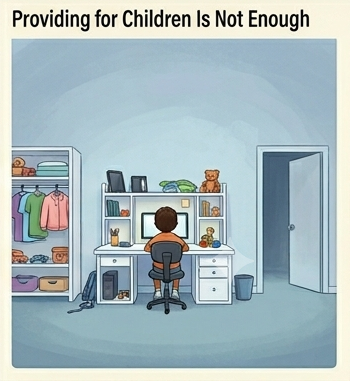
Parents have a responsibility to provide food, clothing, shelter, education, and healthcare. These are essential needs.
However, children also need emotional and relational support.
A child can be well dressed, attend a good school, and have access to material resources while still feeling lonely or unsupported.
Emotional support includes listening, reassurance, affection, patience, and guidance.
Academic support includes routines, realistic expectations, homework assistance, communication with teachers, and assessment when learning difficulties are suspected.
Social support includes attention to friendships, bullying, peer pressure, online behaviour, and the need for healthy belonging.
Spiritual support can help children develop values, identity, hope, discipline, and purpose.
Professional support may include counselling, psychological assessment, medical care, speech and language services, or learning support.
Seeking professional assistance should not be viewed as parental failure. In many situations, it is a responsible decision that may prevent the problem from becoming more serious.
The Community Must Be Accountable
Children need support beyond their immediate household.
Schools, churches, community organisations, counsellors, healthcare professionals, mentors, and relatives can all play important roles.
However, community involvement must include accountability.
There was a time when neighbours watched over children, teachers worked closely with families, and churches provided strong community support. Those were valuable features of community life.
There were also serious weaknesses. Children were sometimes silenced, harsh discipline was accepted without question, and abuse was hidden to protect respected adults or institutions.
A safer community requires clear child-protection procedures, responsible adults, proper supervision, appropriate boundaries, and a willingness to act when concerns arise.
Adults should not be given unrestricted access to children simply because they are familiar, respected, or active in a church or community organisation.
Trust must be supported by accountability.
A Better Approach
Adults do not have to choose between discipline and understanding.
Children need both.
They need adults who will listen and set limits. They need compassion and consequences. They need protection and responsibility. They need connection and correction.
The objective should not be to produce children who are quiet out of fear.
The objective should be to help children understand their emotions, manage their behaviour, accept responsibility, repair harm, and make better decisions.
This requires adults to look beyond the immediate conduct.
We must ask what the child needs to learn, what may be causing the behaviour, whether the child feels safe, and whether additional help is required.
Children will make mistakes. Adults will also make mistakes in the way they respond. Responsible parenting and leadership require adults to reflect, change harmful methods, apologise when necessary, and seek support when a situation is beyond their ability.
Understanding the child behind the behaviour does not weaken discipline.
It makes discipline more effective, more responsible, and more likely to produce lasting change.
Dr. Paul A. Blake, PsyD is a Pediatric Psychologist
Syndicated from Our Today · originally published .
Legal context · powered by Jurifi
Get the legal angle on this story. Pick a prompt and Jurifi's AI will explain it using Jamaican law.
AI replies are based on Jamaican law via Jurifi. Not legal advice.
Other coverage

5K Run/Walk to assist children with special needs
Jamaica Star
Saluting Fathers - An Everyday Activity
PBC Jamaica (Video)Watch
Youth crime: An opportunity problem | Isat Buchanan MP
Jamaica PNP (Video)Watch
Social Media Ban for Jamaican Children | TVJ Smile Jamaica
Television Jamaica (Video)Watch
Noisy church giving us hell
Jamaica Star