
Education Ministry Backs PIOJ Study on Crisis Support for Special-Needs Learners
The Ministry of Education, Skills, Youth and Information has endorsed a Planning Institute of Jamaica (PIOJ) study examining how the school system responds when learners with special educational needs and disabilities face emergencies, describing the work as essential to deepening inclusive education.
“The Ministry warmly welcomes this research. It adds to what we already have in a big way, and we see it as an important contribution… to the ongoing strengthening of inclusive education in Jamaica,” said Dr. Winnie Berry, Deputy Chief Education Officer for Core Curriculum and Support Services.
She said the document sits alongside the Ministry’s current policy suite and supplies useful evidence for refining and rolling out the Education in Emergencies (EiE) policy, as well as Jamaica’s wider push for resilient schooling.
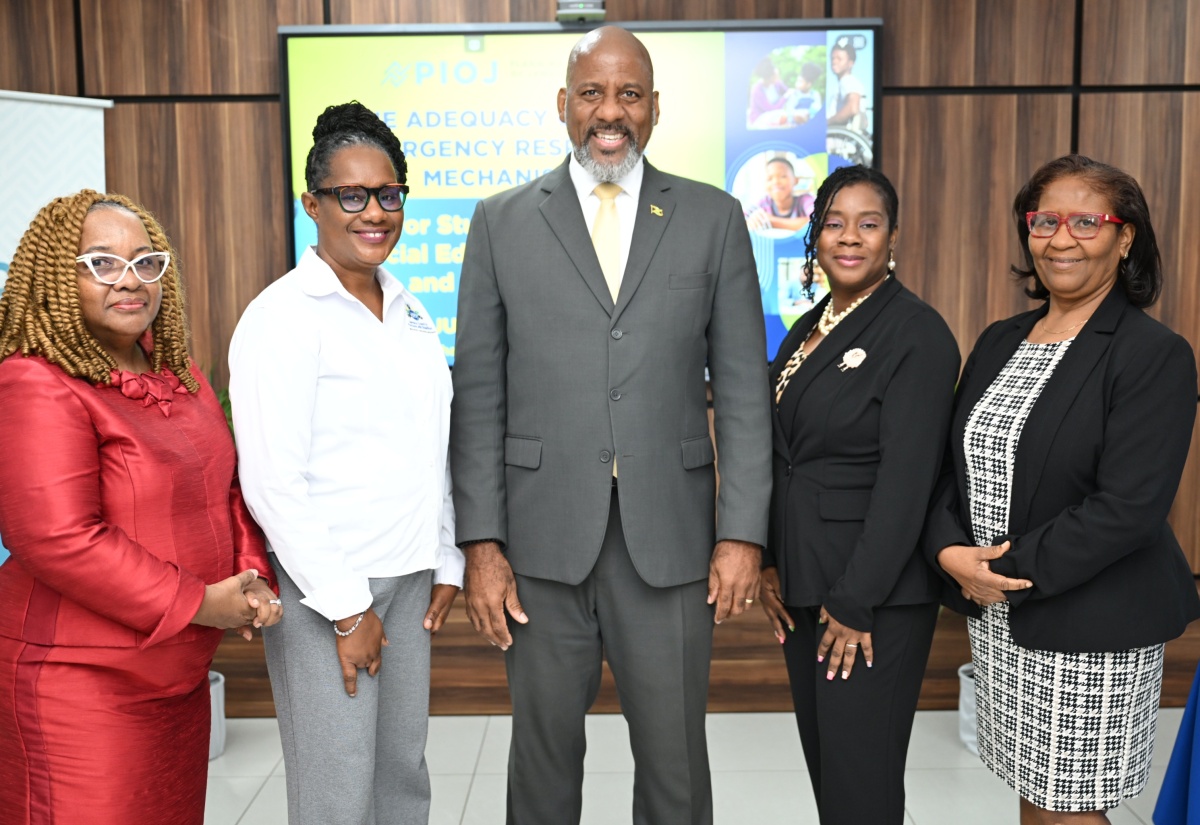
Dr. Berry spoke at a launch event for the report, ‘The Adequacy of the Emergency Response Mechanism for Students with Special Educational Needs and Disabilities’, held Wednesday (July 22) at PIOJ headquarters in Kingston.
Lead researcher Dr. Shakeisha Wilson Scott, of the University of the West Indies’ Department of Sociology, Psychology and Social Work, carried out the project with input from education stakeholders and disability advocates. The inquiry assessed how schools and related institutions plan to shield at-risk students when hurricanes, health crises and other interruptions strike, comparing conditions before, during and after the COVID-19 pandemic.
According to the findings, Jamaica needs a layered emergency approach that reflects climate-related disaster risks, relies on partnerships across many actors, and closes policy and law gaps that hinder a disability-inclusive EiE response.
Dr. Berry argued that solid research underpins sound public policy by revealing shortfalls, guiding where funds should go, tracking results and lifting outcomes for learners. She observed that while schools are often judged in ordinary times, upheaval can expose how systems truly perform, and stressed the need for arrangements that keep learning, care and safety in place ahead of and after disasters.
“This philosophy lies at the heart of the Ministry’s Education in Emergencies Policy. The policy recognises that education is not a service that can simply be paused during emergencies. Rather, it is a protective, life-sustaining public good that provides continuity, stability, and hope for children and their families,” she said.
She added that the policy aims to protect learning results across preparedness, response and recovery, while upholding every child’s rights, welfare and growth. In her view, the PIOJ work backs that stance by showing that learners with special educational needs and disabilities typically face heavier burdens in crises — broken schooling, weaker access to specialist help, technology hurdles and greater psychosocial strain.
“These findings underscore the importance of embedding inclusive emergency planning into every aspect of educational delivery,” Dr. Berry said.
She recalled that the Ministry has long treated fair access as dependent on spotting barriers, meeting individual needs and giving each learner a real chance to thrive. That outlook, she said, shapes the special education policy — which promotes equity, inclusion and suitable provision for learners with exceptionalities, alongside better teacher training, parental involvement and joint support services.
“It is equally reflected in our National Safe School Policy and our Education in Emergencies policy, both of which seek to ensure that schools remain safe, inclusive, and capable of sustaining learning during these difficult times. These policy commitments are translated into practice through the work of the Ministry’s Special Education Unit,” she said.
Continuity of learning, she insisted, must hold even when conditions are severe.
PIOJ Director General Dr. Wayne Henry noted that Jamaica has absorbed three major shocks in five years: the COVID-19 outbreak in 2020, Hurricane Beryl in 2024 and Hurricane Melissa in 2025.
“Among the concerns that arise in the aftermath of such events is the continued education of our student population. This research focused on a particularly vulnerable segment of our population, and the measures in place for their education in emergencies and disasters,” he said.
He said the study surfaces the lived reality of special-needs students and offers proposals meant to improve results.
Jamaica Council for Persons with Disabilities (JCPD) Executive Director Dr. Christine Hendricks said work of this kind supplies the proof required to shift from “good intentions to sound policy”.
“This is why the JCPD places such value on the kind of applied, field-tested research being presented today. It moves us beyond assumption and into evidence. It tells us precisely where the gaps sit between policy on paper and protection in practice, and it gives duty-bearers… clear basis for corrective action,” she said.
Dr. Hendricks said the Council will review the conclusions and advice flowing from the study and expects to partner with the Ministry and others to harden emergency readiness for students with disabilities.
“This includes supporting the training of school personnel, advocating for accessible shelter standards, and ensuring that individualised emergency plans become the standard practice for students with special educational needs and not the exception… This research corrects gaps and it deserves our full attention and our follow-through,” she added.
Syndicated from Jamaica Information Service · originally published .
Legal context · powered by Jurifi
Get the legal angle on this story. Pick a prompt and Jurifi's AI will explain it using Jamaican law.
AI replies are based on Jamaican law via Jurifi. Not legal advice.
Other coverage

No Child Should Be Denied Education Over Unpaid School Fees — Dana Morris Dixon
McKoy's News
Special Education Diagnostic Centre in Portland to Open September
Ministry of Education and Youth
Editorial | Reinforcing investment in girls’ education
Jamaica Gleaner
Role of School Gardens in Strengthening Food Security, Healthy Living Highlighted
Ministry of Education and Youth
Recommendation made for establishment of parent/student support groups for children with disabilities
Jamaica Inquirer