

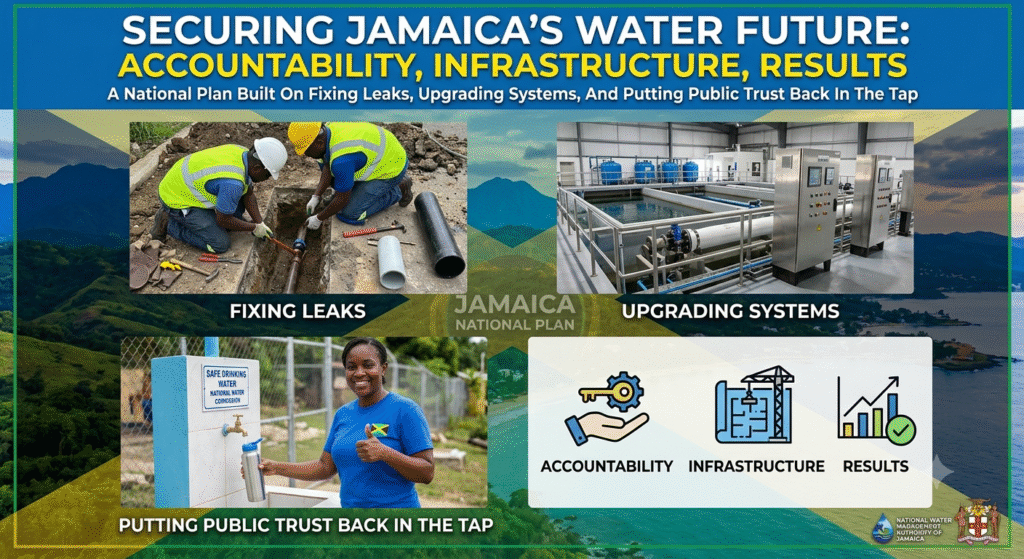
Ian Hayles | Securing Jamaica’s water future: Accountability, infrastructure, results
A National plan built on fixing leaks, upgrading systems, and putting public trust back in the tap

Making his Sectoral Presentation to Parliament, Shadow Minister of Water and Special Projects and MP for Westmoreland Western, Ian Hayles made the point that 24 per cent of Jamaicans are not connectable to potable water and drew attention to the National Water Commission’s liquidity challenges and its inability to make investments in Jamaica’s water supply
Below is his full address:
Madam Speaker, I stand here today in what I still consider an honourable House, yes, Madam Speaker, an honourable House. As I sit here, week in and week out, I cannot help but think that we sometimes do our Jamaican brothers and sisters a great disservice by fueling a narrative that all we do is fight in Parliament. Some even call us the gangs of Gordon House. Yet I know we can send a better message.
So Madam Speaker, we have to ensure that when we come to this house to meet, and the bright lights turn on for the sitting of Parliament, we too shine in a bright positive way.
Madam Speaker, it is my conviction and belief that the People’s National Party has always done a better job in serving the poor and vulnerable of our country,
in serving the marginalised, in serving those who some may consider to be the have-nots. So, Madam Speaker, I don’t fool myself. We are on two separate tracks; we have different belief systems, but we should all be focused on the same destination: a better Jamaica for all Jamaicans.
So Madam Speaker, my approach is simple:
- I came here to work; the people of Western Westmoreland expect me to work. So, we must work together.
- We can agree to disagree, once it does not stop the work of the people. No political party affiliation should punish anyone on this side from getting the resources to do the work of the people.
- And I will always hold the government accountable to do the work of the people!
You see Madam Speaker, this is still the only place I can come:
- to beg roof for the roofless after hurricane Melissa, even when I am told no after no
- to be told by your side, the elected government for all Jamaicans, that because my side is not in power, there is no meaningful help for the roads, no help with water supply, no help for the garbage collection in Western Westmoreland, and the list goes on.
Yet still, I come.
Madam Speaker, I live by the good book, the bible, and as it says in Galatians Chapter 6 Verse 9, “Let us not become weary in doing good, for at the proper time we will reap a harvest if we do not give up.”
So, to my colleagues on my side, I say, let’s not become weary; let’s continue to do good; the time must come! We must be persistent for the people, even when we are told no. Let’s send a message to the country that nothing will stop us from doing their business, the business of the people.
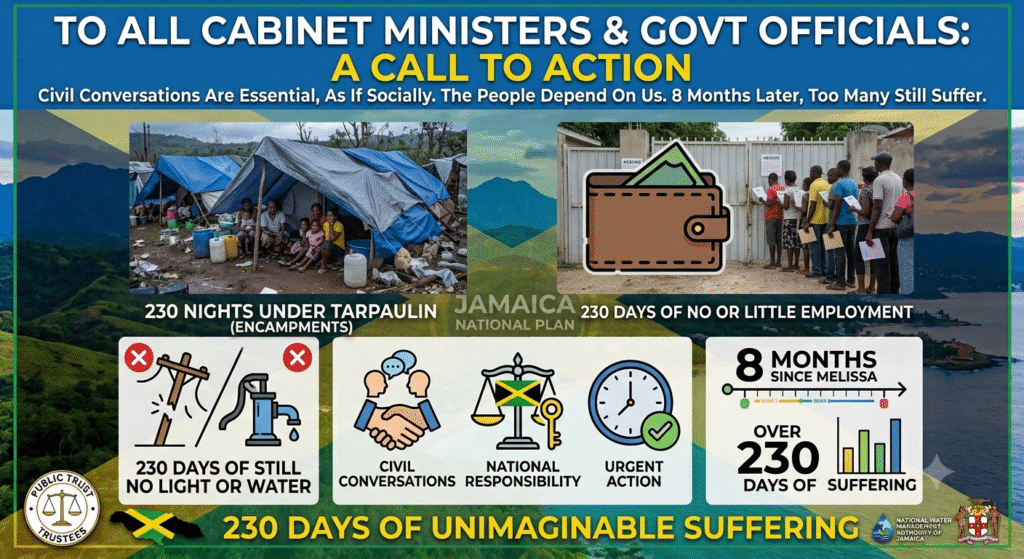
To all Government Ministers and members of Cabinet, I say, let us have civil conversations, as we do in social gatherings, because the people of Jamaica are depending on us. This has never been more urgent than it is now, 8 months after Hurricane Melissa, when Jamaicans in hard-hit parishes continue to suffer, 8 months or 230 days later.
- 230 nights under tarpaulin,
- 230 days of no or little employment,
- 230 days of still no light and no water. And for still too many, 230 days of unimaginable suffering.
Better must be done!
Madam Speaker, I turn now to the immediate matter at hand, the Water Portfolio. Let me say from the outset, I am not here only to criticise today; water is too important to the people of Jamaica and to our future not to offer solutions. But first, we must get a realistic picture of the water situation in our country.
Even though water is life, in 2026, 24% of Jamaican households were still not connected to a potable water supply. In his sectoral debate presentation on April 28th this year, Minister Samuda said that Jamaica stood as 1 of 14 countries that launched a ‘National Water Compact’ with an ambition of ‘water security for 1 billion people by 2030.’
Madam Speaker, if there is one thing for sure, this government is full of acronyms, branding and big words. 2030 is only three and a half years away. There is a lot of work to be done, so let us examine the case together.
In his presentation, Minister Samuda included a table to demonstrate the plan to expand access by constituency. The challenge, Madam Speaker, is that he listed 34 projects across the country at a cost of $4.2 Billion Jamaican Dollars. But $3.65 billion, or 85% of this money, was being spent in constituencies with a JLP Member of Parliament. So, my question, Madam Speaker, is simple: do only constituencies with JLP supporters need expanded access to water? Minister, I put it to you, Jamaicans who voted for the PNP Members of Parliament also need access to water. And to further make my point, remember that JLP supporters also live in constituencies with PNP Members of Parliament.
For this reason, I recommend a transparent system for identifying projects to expand access, and that these projects be published with a quarterly project update. Without this, we will be unable to know whether meaningful progress is being made. In addition, I believe that the Country needs a master plan outlining how water access will be expanded. Jamaica deserves to know;
- where water deserts now exist,
- where only community standpipes now exist,
- where water supply is at low levels
and how you plan to fix it!
It is only with such a deliberate and strategic plan that we can measure true improvement in access. This is how the Minister and the appointed boards should be setting policy direction for the NWC. Every day the hardworking employees of the NWC and other entities get up and go to work, any failure in the system is not their failure; it is a failure of policy and direction!
Until policy and direction are given, the life-changing impact of water will not reach many Jamaicans.
Madam Speaker, the truth is that Jamaica’s existing water systems operate in silos and are inefficient. So, in looking at improved access, I must also speak about linkages, supply and demand.
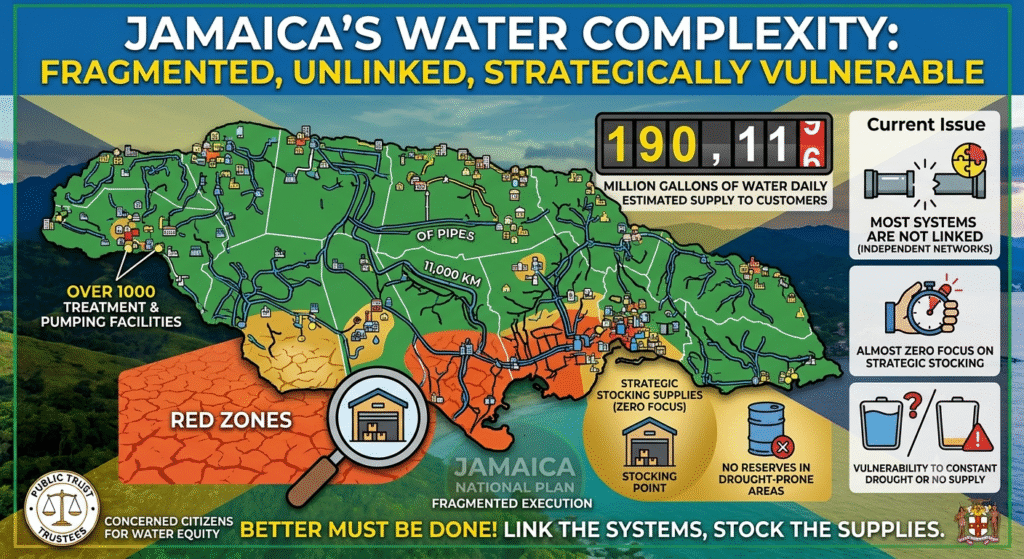
Jamaica has over 1000 water treatment and water pumping facilities and 11,000 kilometres of pipes. It supplies an estimated 190 million gallons of water daily to its customers. Yet most of the systems are not linked. What we have are independent systems with almost zero focus on strategically stocking supplies in areas facing constant drought or no supply.
We must be futuristic in any approach we take as we try to play catch-up; this can be supported by examining the transfer of water via linked transmission lines.
Guided by supply charting and demand planning, there should be a comprehensive assessment and implementation of a large-scale project to link transmission lines, so that, once and for all, people across Jamaica will have the real opportunity to access potable water from existing lines.
Madam Speaker, we know that linkages based on supply and demand work; just look at what is now being done to move water from Martha Brae in Trelawny to the Great River in Hanover, supplying Trelawny, St James and Hanover, where for the first time, thousands of Jamaicans now have access to potable water.
In short, this is an important policy shift, as without linkages, we will continue to truck water across Jamaica for a very long time, with this cycle repeating itself year after year.
But Madam Speaker, while the goal of expanded access is noteworthy, I would also like to recommend to the Minister that he address the inconsistent delivery of water even for those who are already connected. Because, Madam Speaker, let’s not fool ourselves by thinking that once you are connected to a water supply, you will have water. No, a nuh suh it guh.
Those of us in rural Jamaica especially know all too well that when the Jamaica Public Service Company grid goes down, we are not only without electricity, but also hundreds of critical water transmission lines go down also.
Madam Speaker, this was even more evident during Hurricane Melissa. For days, weeks and months, western Jamaica went without light and water. And Madam Speaker, just 18 days ago on June 5th, with the all-island blackout, our water transmission lines went down again. We must improve the energy efficiency of our water supply.
Madam Speaker, I listened to the Water Minister’s presentation, and not enough was said about advanced technology in areas of water treatment or ensuring that we pivot and strategically shift from a system that was solely designed and implemented with only one power generation source. The Minister highlighted
- the solar pumping system installation at three (3) locations under Rural Water Supply, and
- the NWC Forest Hills Solar Project valued at $81.5 million Jamaican Dollars.
The Forest Hills Solar Project represents 10% of the $885.4 million Jamaican Dollars in targeted energy-efficient NWC projects, and is expected to save the NWC $14.2 million Jamaican Dollars per year in electricity costs. While we are happy that it is concluded, the country would be shocked to learn that it is the only project completed for energy efficiency. As a matter of fact, Madam Speaker, of the 13 projects the Minister identified, this is the only 1 completed, and 9 of the projects have not even started.
So Madam Speaker, my advice is let’s not come back next year talking about energy efficiency; action is needed now. We see how fragile our system is in times of crisis and national disaster.
Madam Speaker, we have to ensure that 10 years from now, JPS will not be the primary energy provider but will be the secondary option, operating more like a backup. Madam Speaker, to drive this point home, I want to remind the country that the NWC pays an estimated bill of One Billion Jamaican dollars monthly for electricity to pump water. If the NWC’s JPS bill is cut by 50% over the next 10 years, the company and its customers could save up to J$60 billion.
Can you imagine how many more people in rural constituencies could get water with those savings?
Further, Madam Speaker, the recently published Auditor General report revealed that the NWC owes over $33 Billion Dollars to people and only has about $5 billion in outstanding collections. That nuh mek nuh sense.
The NWC is challenged with liquidity to pay its bills, of which its JPS bills would be one such. The Auditor General’s report said
- In 2016/17, for every dollar owed in the short term, the NWC had 80 cents
- But in FY2023/24, for every dollar owed in the short term, the NWC had 50 cents
They have less cash!
Where is the policy of the board and government? This cannot be how you run a business.
Madam Speaker, energy efficiency solutions are now critical and urgent.
Madam Speaker, the Minister spoke to mobilising investment in the water sector, and this leads me to raise two issues. The first is the current Ad hoc approach to Investment in Water.
Madam Speaker, the Western Resilience Project is being undertaken at a cost of $425 million United States Dollars, with Phase One costing $176 million United States dollars.
It will include the replacement of the transmission main between Montego Bay, the Great River water treatment and the Queen of Spain/New Martha Brae treatment plant in Trelawny, where non-revenue water loss is currently estimated at 71%.
Focus will also be placed on the corridor stretching from the Great River water treatment plant westward through Lucea to the Negril beach strip, where losses run at a high of 68% for NRW.
Madam Speaker, this is all well and good if we had told the people of western Jamaica the truth. The truth is that the entire corridor infrastructure, road and water, is being upgraded for further tourism expansion. But was it necessary and the most cost-effective solution to be done like this?
Madam Speaker, when the minister met with stakeholders in Negril in 2024, the first question I asked myself was: do we, the people of Westmoreland, have the water to expand the system for both residential and tourism consumption over the next 50 yrs? The answer was yes. Why?
- The Roaring River can give you 15 extra million gallons daily
- The Cabarita River can give you a high of 20 million gallons daily ,
bringing the daily available water from these two sources to a total of 35 million gallons extra. Everyday. So why then should we spend nearly half of a Billion USD to give the people of Westmoreland water from Trelawny when water is already in Westmoreland?
Madam Speaker, I can only conclude that it is felt that if you give the people of western Jamaica water before the tourists, for some strange reason, none will be left for the tourism sector. So, in the end, someone made the decision to do the opposite.
The project as it is now designed, will never fulfil the demand downstream and is an ad hoc and wasteful allocation of capital. This $500 Million United States Dollars could have been used to upgrade the parishes of St Ann, St Mary, Portland, St Thomas, St Catherine, Clarendon, Manchester and St Elizabeth.
I am therefore again calling on the government to do a proper analysis of the available water supply, current demand for each parish, and estimates of what that demand will be in 50 years.
This analysis should then be used to guide the policy direction of the NWC board and government to determine capacity-building projects such as this one.
Until then, we will forever be playing catch-up. That is neither building for resilience nor building wisely.
Madam Speaker, the second issue with the level of investment being targeted is that this government has a chronic inability to spend the targeted capital allocation.
Again, from the Auditor General’s recent report, NWC’s total capital budget was unspent for all but 1 year over a 5-year period. In 2019/20, $7.2B was budgeted and $8.9B used. So, they overspent that year, BUT
- 2020/21 – $12B budgeted, 5.5B used. Underspent
- 2021/22 – $9.4B budgeted, 7.3B used. Underspent
- 2022/23 – $8.9B budgeted, 5B used. Underspent
- 2023/24 – $7.4B budgeted, 5.4B used. Underspent
The reasons for underspending, Madam Speaker, vary. From
- delay in execution, up to 2 and a half years after initial due date
- not having pipelines or land access for the work to begin
- poor management & communication with contractors; report says one even walked off the job! Not sure if they have found him yet.
Madam Speaker, just poor oversight.
The Independent Fiscal Commissioner, in early June 2026, highlighted $3.3 billion in Jamaican dollars in capital projects unspent by the NWC and highlighted the risks resulting.
So, if both the Auditor General and the Independent Fiscal Commissioner have raised an alarm, why should we believe the existing lofty capital budgets will be spent? Like every other cabinet member, the Minister spoke to NARRA as the solution; poor NARRA, I wonder if he knows he is expected to solve everything?
Madam Speaker, what we can all agree on is the consequence of not executing the capital projects. As articulated by the Auditor General, this failure “falls on service delivery: planned investments in water, sewerage and treatment infrastructure deferred or scaled back”
In other words, no reliable water for the people of Jamaica!
Madam Speaker, let me now turn to the issue of Non-Revenue Water. Non-Revenue Water continues to hurt the bottom line and affect the financial performance of the National Water Commission, year after year, with no end in sight. It is estimated that 40 – 60% of the water the NWC supplies is classified as non-revenue water. It is not paid for.
On the other hand, we have more than 800,000 squatters in this country, with the majority having access to water, but not paying for metered water. These are Jamaicans who just want to own a piece of the rock to call home and live with dignity, yet they find it difficult year after year to see a path to doing so when applying for metered water. Madam Speaker, the people are losing hope in a system that seems to have been created to hold some Jamaicans back from doing what’s right, at no fault of their own.
Until they own their home, they still need legal access to potable water. This is a must; water is life, and we all want that life. So why are we making it so difficult for people to get water legally?
Thousands of Jamaicans are turned away every year from the NWC offices,
- for land title issues,
- to get landlord permission,
- for no proof of address or national ID or TRN
all this, while the NWC pipeline runs across their doorstep. And we know what our brothers and sisters do out of frustration.
Even those who ‘capture’ a piece of the rock want to have access to paid metered water, once the meter is good.
Madam Speaker, I am recommending that the NWC implement a good-faith application, that once an individual comes through their doors to apply for a meter, that person should be granted a temporary meter connection and given 90 days to complete requirements to regularise the application. Let’s make a real attempt to really start reducing Non-Revenue Water.
Madam Speaker, in concluding my contribution on the water portfolio, I would like to make two general suggestions not already covered as it relates to water.
Firstly, I believe that we must simplify the governance of water in Jamaica. As it stands now,
- Rural water plays an important role in designing and implementing many small projects across many constituencies.
- The National Irrigation Commission, which uses many of the same water sources as NWC, provides water to our farmers, and even some communities consume the same water.
- The Parish Council provides and manages minor water supplies for districts and communities.
- The Water Resources Authority is responsible for the management, protection and controlled allocation and use of Jamaica’s water.
Madam Speaker, all these entities need to be merged into one executive agency that will provide greater oversight, stronger collaboration, and improved flow of project implementation. Importantly, they will cost us as Jamaicans less if consolidated; we would cut waste and be more efficient in deploying staff for maintenance and to carry out projects.
Secondly, as a part of its mandate, the centralised executive agency must ensure that in delivering water services, the Customer Must Come First! Madam Speaker, the customer-focused initiatives must be delivered;
- Smart meter installations so that there can be confidence in billing amounts and consumers are only charged for the actual amount used
- Increased responsiveness so customers can actually speak to someone when they call with a query
- Fixing the issue of air in pipes that give wrong meter readings from defective meters
- Responding to broken lines faster
- And finally, coordination with other agencies to ensure roads are fixed within 48 hours after works are completed
Madam Speaker, if the NWC is to become efficient and profitable, it must focus on improved customer service, deal with the real cause of non-revenue water and remove politics and government policies that favour only one side. This is the only way the NWC can and will become viable.
Before I take my seat, Madam Speaker, allow me a moment to end where I started with my employers, the people of Western Westmoreland. Madam Speaker, of late their challenges have rested heavily on my heart; I don’t even think I have ever had a relationship that pains my heart like how the struggles of the people of Western Westmoreland pain me.
Madam Speaker, firstly, it pains my heart every time a constituent calls to say the police are burning down their ganja field. Ganja farmers are being arrested and charged and everything in between.
So, Madam Speaker, I reflect and reason with myself;
- I have never seen in my lifetime the police burning down the cane field or arresting the cane farmers, even though cane produces rum, and rum can cause harm. But they burn down the ganja fields. Yet Ganja never hurt Jamaica.
- I see where in my lifetime bauxite production has hurt Jamaica; just ask the people of Clarendon, Manchester and St Ann. But we still encourage and support bauxite production. Ganja farming remains unsupported, Yet Ganja never hurt Jamaica.
- In my lifetime, Madam Speaker, tobacco is planted or is imported and comes with a health warning, yet the tobacco fields are not destroyed like the ganja fields and tobacco continues to be imported. Yet Ganja never hurt Jamaica.
Madam Speaker, before the current USA President leaves office, ganja, aka marijuana, aka cannabis, may very well be legalised in all 52 states at the federal level. Madam Speaker, I appeal to the CLA: free up the industry, free up the licences!
I must stop and thank Mark Golding again for his vision and foresight in starting the process of full legalisation.
I also want to thank the Cannabis Licensing Authority and its board, Minister Aubyn Hill and State Minister Seiveright for recently assisting me in trying to ensure that small community farmers who cultivate ganja in Western Westmoreland can now be legalised and farm ganja without fear of being jailed, watching crop go up in flames, being fined or convicted. And most importantly, they can reap what they sow and go home to their families, and not a jail cell after a hard day’s work.
To this parliament, I say, bauxite will be gone soon, sugar is on its deathbed; let’s ensure that we grow and protect the ganja industry. I pledge my full support to the government in developing a legalised industry that will benefit all our people.
Madam Speaker, the government under SCJ Holdings has over 425,000 hectares of land in Westmoreland; most of it is now considered idle land. Once again, let’s free up the licences, and put our legalised ganja farmers to work.
Let’s not fool ourselves, when we sell tourism we sell sun, sea, reggae and ganja. So, every time you hear Minister Bartlett speak about record tourism arrivals, just know one of the reasons why tourists come to Jamaica to make up those numbers is ganja.
Secondly, Madam Speaker, every single day my constituents cry out for road and water. From Sheffield, Ketto, Little London, Orange Hill, Brighton, Little Bay, Broughton, Alma, Grange Hill, Toll Gate, Truro, Townhead, Blackness, Red Hills, Bluearie, they are all crying for road and water. So today again, on behalf of the people, I make a representation.
Duh mi need the help. Please, please.
And third and final for today, Madam Speaker, a large section of employed people in my constituency play a daily role within the tourism sector, delivering Jamaica’s acclaimed tourism product. The results are mixed; multinational profit margins are excellent, and occupancy levels are often high, yet the reality of low wages that our tourism workers earn while working for these multinationals cannot be ignored. And then, Madam Speaker, there are our small, medium-sized operators that built Negril and the tourism sector, who now need some urgent attention, and they need it now.
So, to the government and Minister, I urge you to pay attention to the cries of the small tourism operators in Negril; they need help. They need;
- A special budget to market our small to medium properties in Negril to give them a fighting chance.
- Development of a billion-dollar fund that can be easily accessed without tons of red tape and bureaucracy. This would allow those who worked long and hard to build the tourism industry to access money to retrofit, allowing them to compete.
- The entire Norman Manley Boulevard to be addressed; it floods after a heavy shower of rain.
- The same Norman Manley Boulevard, West End and the town of Negril are dark every night. Even if tourists wanted to walk along the strip, they could not because of the darkness. Recently, the Tourism Enhancement Fund installed 30 lights, but that is only a start. We need many more streetlights for the benefit of both the citizens and the tourists.
- An expanded sewage system in Negril to keep pace with the expansion in the town
- A proper garbage collection and disposal system for the entire resort town
Madam Speaker, Negril needs attention now!
Madam Speaker, to drive my point home, what Negril contributes to the consolidated fund cannot be measured in numbers, and the Ministry of Finance will tell you that we don’t get back the equivalent in infrastructure development. The government must take a serious look and put a plan of action in place. I encourage the responsible cabinet members to just pick up the phone and talk to some of the stakeholders in Negril, call Lee Issa, call Daniel Grizzle, call Lenbert Williams, call Elaine Bradley, call Richard Wallace, call Damian Salmon, get their thoughts, their everyday reality, their input. As Mr Penny would say, we are tired of the promises; we are tired of the fancy documents; let’s get some action now.
Madam Speaker, in closing, I want to thank the people of Westmoreland Western for doing their best, one day at a time, every day just trying to make life happen. I am so proud of them. In their darkest hour, in their moments of questioning why Westmoreland, they still fight to keep hope alive.
For those of you in Western Westmoreland who are still without a roof and trying to rebuild, I know you are trying. Keep that hope alive, knowing that this Member of Parliament, your Member of Parliament, will continue to fight on your behalf, whether you voted PNP or JLP, because in the end, whichever track you are on, we all say Jamaica, the land of our birth.
Syndicated from Our Today · originally published .
Legal context · powered by Jurifi
Get the legal angle on this story. Pick a prompt and Jurifi's AI will explain it using Jamaican law.
AI replies are based on Jamaican law via Jurifi. Not legal advice.
Other coverage
Official Opening of the Troy Bridge
Office of the Prime Minister
CVM News At 7PM: June 26, 2026 | @CVMTVNews
CVM TV News (Video)Watch
Handing Over Ceremony for Malvern Housing Development
Office of the Prime Minister
Jamaica Magazine - 26.06.2026
Jamaica Information Service (Video)Watch
Jamaica Magazine-28.06.2026
Jamaica Information Service (Video)Watch