
Itamar Ben-Gvir and the hard-right politics reshaping Israel
Israel’s National Security Minister Itamar Ben-Gvir has again placed himself at the centre of international anger, giving outside observers a harsher view of what he presents as contemporary Israel. In recent weeks, he told reporters he would “not allow” any United States ceasefire arrangement with Iran that he believed would harm Israel, and he was later shown on television confronting restrained activists from the Global Sumud Flotilla. Those episodes prompted widespread condemnation abroad.
For some time, critics of Israel’s far-right parties at home and partners overseas found it useful to describe Ben-Gvir, who leads the Jewish Power party, as an exception inside Prime Minister Benjamin Netanyahu’s governing bloc. That framing made it easier for domestic opponents of the far right to keep backing the administration and for foreign governments and businesses to continue dealings with Israel despite mounting criticism of its government.
The reaction to Ben-Gvir’s treatment of the mostly European flotilla activists came from the United Kingdom, France, Italy, Canada and even close Israeli allies in the United States. Netanyahu, seeing the reputational cost, said the episode was “not in line with Israel’s values and norms”. Foreign Minister Gideon Sa’ar issued an even sharper response, accusing his cabinet colleague of deliberately hurting Israel and saying Ben-Gvir was “not the face of Israel”.
That same message has been repeated in several Israeli media spaces, where commentators have tried to distance Ben-Gvir from the wider state and government. Yet his position, influence and public appeal suggest something different: that he represents a powerful and growing current in Israeli society.
“He’s stupid, which tells us he’s not acting on his own,” Knesset member Aida Touma-Sliman of the left-wing Hadash party told Al Jazeera. “Everything he’s doing he’s doing with the help of other politicians and civil servants who share his beliefs. He wouldn’t be able to do what he does if they weren’t helping him.”
Since taking over the newly formed National Security Ministry in 2022, Ben-Gvir, a convicted inciter, far-right agitator and political provocateur, has held sweeping authority over the police and prison systems without meaningful restraint.
“If just one policeman said no, you can’t politicise the police force, that would be it,” Touma-Sliman said. “If the head of the prison service said no, you can’t starve, torture and sexually abuse prisoners, they wouldn’t, and that would be it.”
Ben-Gvir was already a national figure long before he entered government. He first became widely known in 1995, after Prime Minister Yitzhak Rabin signed the Oslo Accords with the Palestine Liberation Organization, agreements many international actors hoped would lead towards a two-state settlement.
Then 19, Ben-Gvir appeared on camera smiling as he displayed the Cadillac hood ornament taken from Rabin’s vehicle. “We got to his car, we’ll get to him, too,” he said. A few weeks afterwards, Rabin was murdered by Yigal Amir, a right-wing extremist and ultranationalist.
Ben-Gvir was born in 1976 in a small community west of Jerusalem. In a 2021 interview with Mako, he said he became religious at age 12 and turned radical at 14 because of what he described as violence during the First Intifada. One of his teachers recalled that, like many high school students of the period, he openly supported Kach, the extremist movement established by American-Israeli rabbi Meir Kahane.
Kach was outlawed in 1988 after judges ruled it violated constitutional changes introduced that year. In 1994, it was classified as a terrorist organisation after Baruch Goldstein, a member of the movement who invoked Kach ideology, killed dozens of Palestinian worshippers in Hebron.
Goldstein became a recurring reference point in Ben-Gvir’s public life. Reports say he took the woman who later became his wife to Goldstein’s grave on their first date. He also dressed as Goldstein for Purim and kept the killer’s picture in his home until campaign advisers urged him to remove it in 2021.
Ben-Gvir was indicted 53 times over his activism and later told Haaretz that, after he succeeded in getting most of the cases thrown out, judges suggested he should study law. But two cases in 2007 ended in convictions for inciting racism and supporting a terrorist organisation. Those charges followed his arrest while carrying signs that read, “Expel the Arab enemy,” and “Rabbi Kahane was right: The Arab MKs are a fifth column,” referring to Arab members of Israel’s parliament.
In 2012, Ben-Gvir qualified as an attorney despite opposition from the Israeli Bar Association, which had sought to block him because of his criminal record. He went on to build a legal profile representing far-right settlers and hardline activists.
His links to that political world caused further controversy in 2015, when he was photographed at the wedding of Amiram Ben-Uliel, a settler later convicted of killing a one-year-old child and the child’s parents by firebombing their home in Duma, an occupied West Bank village. Video from the wedding showed attendees dancing with knives, assault rifles and a Molotov cocktail, while one person repeatedly stabbed a photograph of the infant victim.
Ben-Gvir defended the event, saying, in a claim widely met with disbelief, that “no one realised these were photos of a member of the Dawabsheh family”.
Ofer Cassif, a Knesset member who had challenged Ben-Gvir’s right to run for office, gave Al Jazeera a description of him that differs sharply from the genial image sometimes presented in Israeli media. “I’ve never seen Ben-Gvir laugh or joke. He’s a bully, but the kind of schoolyard bully who shuts up as soon as the teacher raises their voice,” Cassif said. “Ben-Gvir is a violent man. I mean, he has convictions for supporting terrorism and had a picture of Baruch Goldstein on his wall.”
In 2022, Netanyahu helped bring Ben-Gvir and Bezalel Smotrich, leader of the far-right Religious Zionist Party, into a firmer alliance as public support turned away from the broad government led by Naftali Bennett and Yair Lapid. After earlier joint electoral efforts in 2019 and 2021, their bloc returned to parliament as the third-largest faction, helping Netanyahu sustain his coalition. Analysts say the pair have become visible representatives of the government’s most extreme right-wing tendencies.
Since then, analysts and activists have accused Ben-Gvir of pushing Israel’s police apparatus towards his own hard-right outlook. He has used social media to celebrate harsher conditions for Palestinian detainees, including many being held without charge, while also defending the rape and starvation of other prisoners.
Ben-Gvir has repeatedly threatened to bring down the coalition if Israel’s assault on Gaza is reduced. He has also led several entries into the Al-Aqsa Mosque compound, one of Islam’s holiest sites, despite government policy.
After the Hamas-led attack on October 7, 2023, Ben-Gvir oversaw a sharp rise in gun licences issued to Israeli settlers in the occupied West Bank. Deadly attacks on Palestinians have increased since then, as critics had warned.
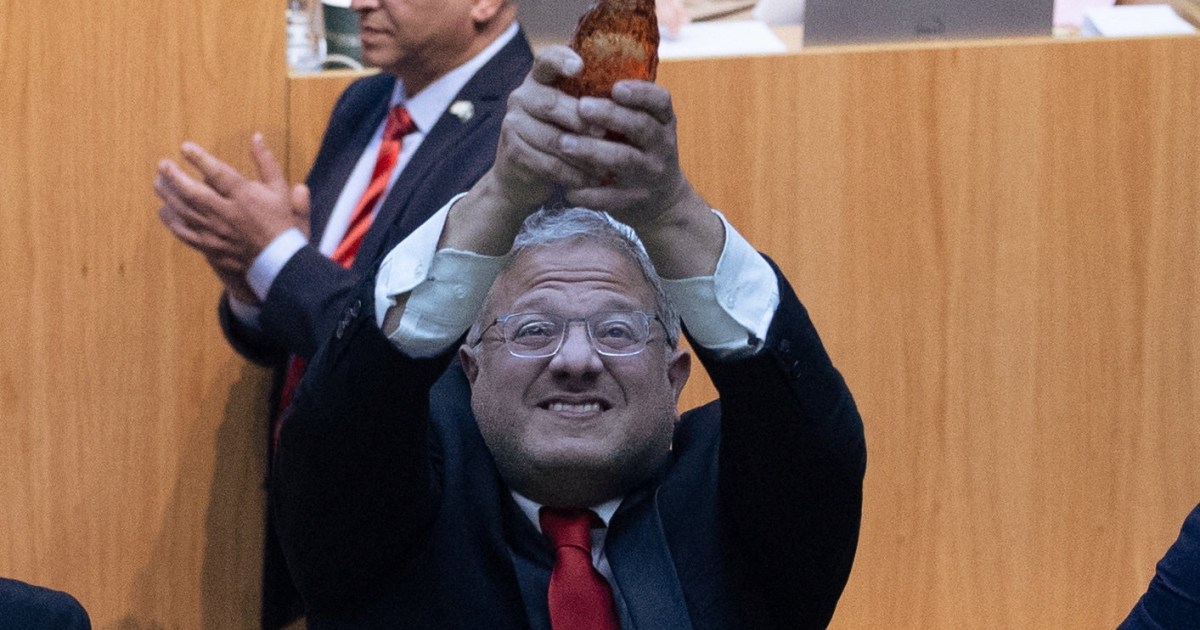
In April, attention abroad again turned to Ben-Gvir after footage showed him holding a bottle of champagne while celebrating the passage of a bill aimed at applying the death penalty to Palestinians.
Former Israeli government adviser Daniel Levy said much of the anger over Ben-Gvir’s conduct towards the Sumud activists in May focused on the public display, rather than on what the detainees experienced in Israeli custody.
“To my mind, it’s the easy target. The argument being made is that the problem is Ben-Gvir going out and posting a video, rather than the way they treat the flotilla, the settlers, let alone the way they treat Palestinians,” Levy said. “They aren’t changing their policies whatsoever. No one is questioning what they actually do in Gaza, the West Bank, the flotilla, Lebanon, etc. Instead, they’re questioning the style of one minister.”
Even with the international criticism, Ben-Gvir’s support appears steady, while the standing of Smotrich, his more restrained partner on the extreme right, seems to be weakening.
Israeli pollster Dahlia Scheindlin said Ben-Gvir’s views are often not far outside positions held by many members of the governing Likud party. “[He] represents a populist far-right Jewish supremacist politics with a theatrical, provocative, circus style familiar from nationalist-populist politicians around the world,” she told Al Jazeera. “His supporters could be secular, traditional or religious right-wingers who believe that threats from Palestinians can only be addressed through force and humiliation.”
Ben-Gvir was asked to answer the issues raised in the report, but had not responded by publication time.
Syndicated from Jamaica Inquirer · originally published .
Legal context · powered by Jurifi
Get the legal angle on this story. Pick a prompt and Jurifi's AI will explain it using Jamaican law.
AI replies are based on Jamaican law via Jurifi. Not legal advice.
Other coverage

Finding Your Own Spotlight | TVJ Smile Jamaica
Television Jamaica (Video)Watch
Rising above - Studio One youth earns dental degree from Rutgers
Jamaica Gleaner
From Cane Fields to Classroom: A Story of Struggle and Survival | TVJ Profile
Television Jamaica (Video)Watch
If Antony Anderson is PM Holness’ cousin, does it prove problematic for NaRRA?
Our Today
Israel Bracing For Further Hezbollah Attacks | TVJ News
Television Jamaica (Video)Watch