

Company Snapshot
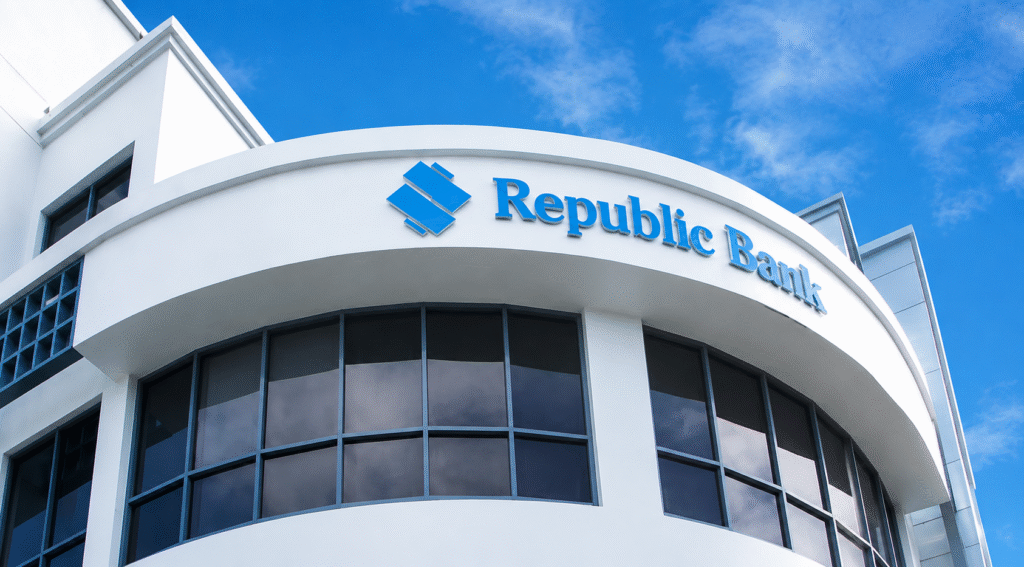
Company name: Republic Financial Holdings Limited
Ticker: RFHL
Exchange: Trinidad and Tobago Stock Exchange
Sector: Banking and financial services
Primary business activity: Commercial banking, corporate banking, retail banking, wealth management and regional financial services
Geographic exposure: Trinidad and Tobago, wider Caribbean and selected international markets
Why It Is Being Watched Today
Republic Financial Holdings is being watched because it remains one of the Caribbean’s most systemically important financial groups, while recent market trading has again highlighted the thin-liquidity reality of even the region’s largest listed companies. The stock remains a core reference point for investors seeking exposure to regional banking, dividend capacity and balance-sheet strength.
The group’s latest half-year performance also keeps it in focus. RFHL reported profit attributable to equity holders of approximately TT$1.07 billion for the half year ended March 31, 2026, supported by growth in loans and investments. Total assets stood at approximately TT$133.7 billion at March 31, 2026, up 5.5 per cent year over year.
Recent Market Performance
RFHL closed at TT$107.24 on June 25, 2026, down TT$1.26 on the session, with reported volume of 443 shares. That trading pattern underlines a familiar feature of the Trinidad and Tobago Stock Exchange: major companies can still trade with limited daily volume, so price movement must be interpreted with care.
The latest publicly available data reviewed did not provide a clean 52-week high and low in the accessible market summary. Market capitalisation data was available through exchange-based market information, but daily liquidity remains the more important practical consideration for short-term investors.
Business and Financial Context
Republic’s earnings are anchored by banking spreads, loan growth, investment portfolios, fees and diversified regional operations. It is not a narrow Trinidad banking story. The group’s footprint gives it exposure to multiple economies, currencies and credit cycles across the region.
That diversification is a strength, but it also creates complexity. Caribbean banks operate in markets where foreign exchange availability, sovereign exposure, regulatory capital requirements and uneven credit demand can all influence results. RFHL’s size provides resilience, but the group still has to navigate the limits of relatively small and sometimes slow-growing economies.
For investors, the attraction is not aggressive growth. It is earnings durability, balance-sheet scale and the ability to distribute capital while maintaining financial strength.
Investment Case
The bull case is straightforward: RFHL is one of the strongest regional financial platforms available to public-market investors. It offers scale, diversification, banking-system relevance and a long track record of operating through cycles. For investors seeking defensive financial exposure, it remains one of the region’s more important counters.
The bear case is also clear. The stock is exposed to thin trading, regional macroeconomic risk, foreign-exchange constraints, interest-rate movements and credit-cycle pressure. Large banks can appear stable until asset-quality or capital-allocation issues emerge. Investors must therefore assess not only reported profit, but the quality of loan growth, provisioning and the sustainability of returns across markets.
Regional Relevance
Republic matters beyond its share price because it is a proxy for confidence in Caribbean banking. Its loan book, deposit base and capital position speak directly to business activity, household credit, corporate investment and the strength of the wider financial system.
In a region where capital markets are still developing, institutions like RFHL carry added significance. They are not only listed companies; they are financial infrastructure. Their results help investors read the health of the broader economy.
Analyst’s Read
Neutral Watch. RFHL remains a defensive regional financial name with scale and earnings depth, but thin daily trading and broader Caribbean macro risks mean the stock should be assessed with patience rather than urgency. The recent share-price softness is worth watching, but it should not be overread in isolation.
Disclaimer: This article is for informational purposes only and does not constitute investment advice.
Syndicated from Our Today · originally published .
Legal context · powered by Jurifi
Get the legal angle on this story. Pick a prompt and Jurifi's AI will explain it using Jamaican law.
AI replies are based on Jamaican law via Jurifi. Not legal advice.
Other coverage

Dr. Marlene Street Forrest: Financing For Success
Jamaica Stock Exchange (Video)Watch
Angus Young: Broker Dealers - The Conduit For Businesses To Access Capital For Growth & Expansion
Jamaica Stock Exchange (Video)Watch
The Business Report—June 24, 2026
PBC Jamaica (Video)Watch
Magnifying Emerging Entrepreneurs: JSE Micro Market Launch | Business News: June 23 | @CVMTVNews
CVM TV News (Video)Watch
Sygnus Signs Historic US$15m Investment Deal with the IFC
CVM TV