
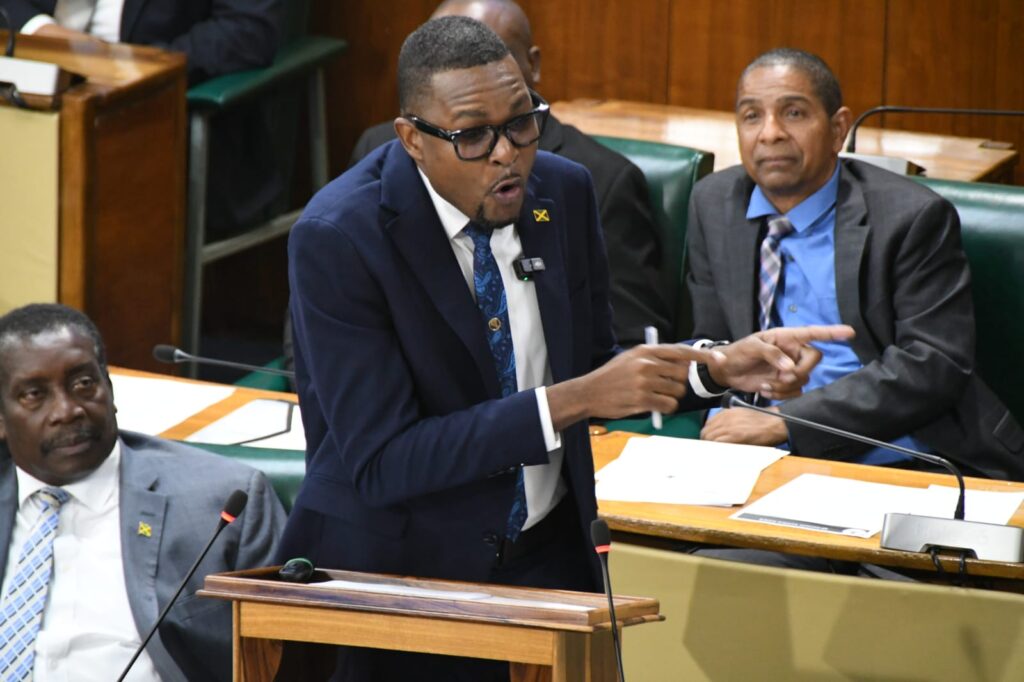
Politicians highlight need for collaboration to achieve sustainable infrastructure
KINGSTON, Jamaica — Minister with responsibility for Works, Robert Nesta Morgan, says infrastructure is one way to foster equality, admitting that locally, the quality of life is often tied to where you live.
“We see a divide between communities that were formally planned and ordered and communities that grew without adequate planning, often in environmentally hazardous areas with infrastructure that is not up to modern standards,” he said.
He was speaking on Monday at the 15th Caribbean Urban Forum at the Courtleigh Auditorium.
The gathering focused on building a more resilient Caribbean and saw officials, planners, and development experts meet to discuss solutions for climate adaptation, sustainable growth, and stronger cities across the region.
Set to last from June 17 to 19, the opening day featured a strong line-up of speakers from both sides of Parliament, drawing attention to major issues facing the region’s cities.
Among those addressing the forum were Morgan, speaking on behalf of Prime Minister Andrew Holness, Mayor of Kingston Andrew Swaby, Minister of Local Government Desmond McKenzie, and Opposition Leader Mark Golding.
Noting that often disasters do not cause but reveal vulnerabilities across the Caribbean, Morgan said: “They reveal them because in many cases the planning was weak, where land use was unsafe, where drainage was inadequate, where infrastructure was absent, where enforcement was inconsistent.”
“The resilient city is not only the city that recovers after the disaster. It is the city whose systems function before the disaster,” he said.
Morgan went on to admit that in Jamaica, the quality of urban life depends on where you live.
“The more affluent neighbourhoods are subsidised by the inefficiency of planning and enforcement, where many of their employees are forced to live in substandard environments. If we are serious about resilient cities, this must change,” he stressed.
Morgan maintained that infrastructure is one of the ways government can translate inclusion into practical access to work, school, health care markets, public safety, emergency response and economic opportunity.
Noting that Kingston’s geography presents both opportunities and challenges, Swaby said intense rainfall events continue to place pressure on drainage systems and waterways while rising temperatures underscore the growing urgency of climate adaptation.
“We are therefore pursuing initiatives aimed at improving environmental stewardship, promoting green infrastructure, enhancing watershed management, and increasing urban tree cover to create cooler, healthier, and more resilient community.”
Opposition Leader Mark Golding lauded the regional event, maintaining that collaboration is a necessary step to sustainable infrastructure.
“We’re too small to individually think we can achieve optimal solutions to our problems on our own, and that’s why regional thinking and regional responses deliver better outcomes over the long term,” said Golding.
Reflecting on the lessons to be learned from Hurricane Melissa, which passed the island in October 2025, devastating the western portion, Golding said “There are many important lessons to be learned from the disaster that we just confronted and if we don’t learn them, we’re going to be worse off for it, especially if we have the misfortune of going through something like that again.”
He called for the creation of an assessment tool or body to examine hurricane response, acknowledging that both the government and opposition have opposing goals when assessing the country’s response, with the government hoping to present itself well and the opposition hoping to expose weaknesses of the response.
Similarly, McKenzie noted that: “Criticisms are good, constructive criticisms. But as a country, we have paid a price for too long for being too partisan. Jamaicans need to unite.”
He noted that between 2011 and 2022, there was an 11 per cent increase in the number of urban districts across the country, with 61 per cent of people living in cities and towns and 39 per cent living in rural areas, with most parish capitals (10 out of 14) being situated near the sea.
“We must build a stronger Caribbean,” he stressed.
Their remarks highlighted the importance of urban development, collaboration, and solutions to the challenges affecting Caribbean communities.
Syndicated from Jamaica Observer · originally published .
Legal context · powered by Jurifi
Get the legal angle on this story. Pick a prompt and Jurifi's AI will explain it using Jamaican law.
AI replies are based on Jamaican law via Jurifi. Not legal advice.
Other coverage
Holness cites Dubai and Singapore as models for Jamaica’s development push
Jamaica Gleaner
Spring Village residents finally get new bridge after four-year ordeal
Jamaica Gleaner
Caribbean Roundup: Antigua and Barbuda, Barbados, Cuba, Guyana, and more
Caribbean Life
PM Holness: Private Sector Should Help Bridge Housing Gaps | TVJ News
Television Jamaica (Video)Watch
CVM Sunrise Morning Show: June 16, 2026 | CVMTV
CVM TV (Video)Watch