

Speaking Notes: Review of Economic Performance, July–September 2025
1 The Planning Ins titute of Jamaica’s Review of Economic Performance, July – September 20 2 5 Media Brief November 2 5 , 20 2 5 1. Overview – Current Economic Context Before I provide the details on economic performance, let me take this opportunity to remind you of the purpose of these quarterly economic estimates provided by the PIOJ. These preliminary figures are released approximately six weeks after the end of each quarter and are based on the most current data available from key sources. They provide an early indication of economic trends and performance across major industries . The release of preliminary estimates aligns with international best practices, where it is standard procedure for economies to publish early indicators ahead of final official figures. In the case of Jamaica, the PIOJ releases the preliminary growth estimate within the first six weeks following the end of the quarter being reviewed , and ST ATIN releases the official GDP figures at the end of the 3rd month following the quarter being reviewed.
2 The preliminary out - turn is used by various stakeholders, including our International Development Partners, the Private Sector, as well as the Govern ment, for whom the magnitude and direction of sectoral performance is critical to inform planning and policy - related decisions. Today , we are reporting that the economy grew by a n estimate d 4.6 % during the July – September 20 2 5 quarter, relative to the corresponding quarter of 20 2 4 . T he estimated out - turn for the review quarter largely reflected recovery from the low production base experienced in the similar quarter of 2024. The economy recorded relatively strong growth driven mainly by the industries that were most impacted by Hurricane Beryl , that caused damage estimated at $56.7 billion (Jamai can) in the corresponding quarter of 2024. These industries were Agriculture, Forestry & Fishing; Electricity, Water Supply & Waste Management; Accommodation & Food Service Activities; and Mining & Quarrying, which benefited from improved operational condi tions and greater demand. As a consequence, both the Goods Producing and Services Industries recorded growth. 2. Real Sector Developments Developments in the Goods Producing Industry The Goods Producing Industry is estimated to have expanded by 10. 0 % , driven by increased output across all industries . Agriculture Real Value Added for the Agriculture, Forestry & Fishing industry grew by 23.9% , based on PIOJ ’ s production index, reflecting the full recovery from the effects of Hurricane Beryl.
3 This improved performance was evident in the performance of the Other Agricultural Crops component, which was estimated to have expanded by 2 6 . 8% . Higher production was recorded for all nine crop groups, with the largest increases recorded for: Cereals, up 76.5 %; Condiments, up 43.3 %; Vegetables, up 36.6 %; and Fruits, up 29.9 %. Additionally, increased output was recorded for Traditional Export Crops , which grew by 40.6 %, largely reflecting increases in the production of banana , up 44.4%; Coffee up 162.4%; and Sugar Cane up 51.7% . Animal farming wa s estimated to have increased by 3.7 % due to the combined effect of higher Poultry meat production, up 7.2% and lower egg production, down 24.9%. Mining & Quarrying Real Value Added for Mining & Quarrying grew by 3.8%, reflecting higher output in the Bauxite & Alumina and Quarrying Sub - industries. Alumina production grew by 2.0 %, due to a n expansion in the alumina capacity utilization rate to 37. 8 %, up 0.7 percentage point , compared with the corresponding quarter of 202 4 . Crude Bauxite production also increased, with production up 22.2 % , reflecting higher demand from overseas purchasers. The average bauxite capacity utilization rate rose to 33.3 %, up 6. 1 percentage points. The Quarrying sub - industry was also estimated to have grown , reflecting higher production for five of the ten industrial minerals surveyed . The largest absolute increases were recorded for Whiting, Shale, and Gypsum .
4 Manufacturing Real Value Added for the Manufacturing industry increased by an estimated 4. 4 %, due to higher output in the Food, Beverages & Tobacco and the Other Manufacturing sub - industries. The expansion in the Food, Beverages & Tobacco sub - industry stemmed from a rise in the production of Poultry Meat up 6.4%, Dairy Products, up 4.4%, Sugar, up 55.3%, Molasses up 335.8% , Rum & Alcohol, up 84.7% and Carbonated Beverages, up 3.2% . In the case of the Other Manufacturing sub - industry growth primarily stemmed from higher production of Petroleum Products and Non - metallic Minerals. Production of all Petroleum Products surveyed increased , led by : Turbo Fuel up 70.9%, Fuel Oil, up 14.9%, LPG, up 127.4%; Automotive Diesel Oil , up 28.8% and G asoline, up 34.6% . The Non - metallic Minerals category also contributed to the higher output , driven by increases in the production of Cement ( up 51.9 % ) and Clinker ( up 98.2 %). Construction Real Value Added for the Construction industry was estimated to have grown by 4 .8% , reflecting estimated growth in both the Building Construction, and Other Construction component s of the industry . Th e industry’s performance was supported by a 2.5 % real increase in the sales of construction - related inputs. The performance of the Building Construction component was due mainly to the growth in the residential category . Housing starts by the NHT increased by 391.4 per cent driven primarily by the 750 new housing starts at the Friendship Oaks Phase II development in St. Elizabeth. The expansion in the Other Construction component was due to an increase in capital expenditure on civil engineering activities , largely stemming from :
5 1. National Works Agency, which disbursed $1.9 billion, an increase of 55.5 % relative to the corresponding quarter of 2024. The increased expenditure was associated with road construction works on the SPARK programme, the Troy Bridge and the dualization of the Braeton and Hellshire main roads. 2. National Road Operating & Construction Company (NROCC), disbursed $2.4 billion, an increase of 41.9 % relative to the corresponding quarter of 2024. Expenditure during the review quarter was primarily on the Long Hill bypass component of the Montego Bay Perimeter Road project. 3. JPS , which disbursed $ 1. 9 billion, an increase of 57.9% relative to the corresponding quarter of 202 4 . Disbursements during the quarter included expenditure on activities related to the transmission, distribution and generation of electricity , and 4. Port Authority of Jamaica, which disbursed $1.4 billion, up 55.1% for works related to Berth construction and expansion at , the Ocho Rios Cruise Pier the Falmouth Cruise Pier, the Caymanas Economic Zone as well as other projects. Developments in the Services I ndustry The Services Industry was estimated to have increased by 3. 0 % , relative to the corresponding quarter of 202 4 , reflecting higher Real Value Added for all i ndustries . Electricity , Water Supply & Waste Management The Electricity, Water Supply & Waste Management industry was estimated to have recorded an increase in R eal V alue A dded of 6.6 %, reflecting higher electricity and water consumption , stemming from the recovery from the damage caused by Hurricane Beryl in 2024. Electricity consumption grew by 8.1 % , reflecting higher consumption for all six categories :
6 • Residential, up 10.2% • General Service [ small businesses using less than 25 kilo Volt ampere ( kVa) ] , up 8.0% • Large Power (Businesses using more than 500kVa), up 10.6% • Power Service (large businesses using more than 25 kVa but less than 500 kVa), up 6.2% • Largest Power (single locations with a minimum peak demand of 2000 kVa), up 2.0% • Street Lighting & Traffic Signals, up 10.2%. W ater consumption grew by 3.6 %, r eflecting the combined impact of a 6.2 % increase in the West ern Division and a 2.2 % in crease in the Eas tern Division. Higher consumption was recorded in 12 of the 14 Parishes led by Manchester, up 16.1 %; Hanover, up 13.7% and St. Ann , up 13.3 %. Transport & Storage Real Value Added for the Transport & Storage industry grew by 5.2 % relative to t he corresponding quarter of 2024 . This was due to higher levels of activities in both the Transport and Storage components, driven by: • An increase in the air transport sub - component, reflecting a 5.6% upturn in passenger movement, stemming from Departures (up 5.7%); and Arrivals (up 6.8%) • Growth in maritime transport activities , reflecting a 12.6% increase in total cargo handled , due to Port of Kingston, up 5.7%, and Outports, up 14.4%. Wholesale & Retail Trade; Repairs; Installation of Machinery Equipment (WRTRIM) Real Value Added for the WRTRIM industry was e stimated to have expanded by 4.7 %, due to:
7 • An estimated real increase of 8.2 % in real gross sales • Growth in the related Agriculture and Manufacturing industries; and • A strengthening in Business and Consumer confidence, up 8.7% and 18.0% , respectively . Higher sales were recorded for seven of the eight categories, including: • Hardware, Building Supplies and Electrical Goods and Machinery, up 2.6% • Motor Vehicles, Auto Repairs & Accessories, up 26.6% • Agriculture, Food, Beverages & Tobacco, up 7.4%, and • Wholesale of Household Goods & Office Equipment, up 8.4%. Financial and Insurance Activities Real value added in the Financial and Insurance Activities industry grew by 1. 5 %. This out - turn was attributed to greater revenues earned at deposit - taking institutions from net interest income, fees and commission. Accommodation & Food Service Activities Real Value Added for the Accommodation & Food Service Activities industry was estimated to have grown by 3.6 % . Preliminary data indicate that stop - over arrivals for July and August 2025 was 535,643 visitors , representing an increase of 7.0% . Preliminary Foreign exchange earnings for the period was US$786.8 million, an increase of 10.1%. GDP Performance: January – September 20 2 5 For the first nine months of 20 2 5 , real GDP wa s estimated to have in creased by 2 .4 %. Th is reflected hig h er R eal V alue A dded of 5.0 % for the Goods Producing Industry, and 1.6% for the Services Industry .
8 The most significant drivers of this performance were Agricultur e, Forestry & Fishing, up 11.3%; Accommodation & Food Service Activities, up 2.9%; and Construction, up 2. 6 % . 3. Employment Update…. Turning to highlights of the July 2025 Labour Market Survey fielded by STATIN, the data indicated that: • The Employed Labour Force was 1 441 100 as at July 2025, an increase of 32 100 persons • The unemployment rate was 3.3% , with Male unemployment rate at 2.4% and Female unemployment rate at 4.4% • The youth unemployment rate was 10.2% , with Male youth unemployment at 8.3 % and Female youth unemployment at 12.5% • The unemployed labour force declined by 6.5%, reaching 49 200 individuals • The number of persons outside the labour force contracted by 28 700, reaching 665 500 individuals. 4. Short - Term Economic Outlook: October – Decem ber 20 2 5 and Fiscal Year 202 5 /2 6 We will now turn to the short - term prospects for the Jamaican economy. T he prospects are generally negative , reflecting the impact of the passage of Hurricane Melissa. This outlook stems from the devastati on which the Category 5 hurricane had on residential and productive assets , to include housing stock, the electricity generation, transmission and distribution network, the road network and water supply and telecommunication infrastructure .
9 It is expected that there will be a significant fall in output and demand during the short to medium term. This outturn, would end the 3 consecutive quarters of economic growth, which reflected the gradual recovery , following the passage of Hurricane Beryl and Tropical Storm Rafael, during the latter half of 2024. The extent of the damage from Hurricane Melissa is unprecedented and far - reaching, affecting all industries. This is expected to result in increased unemployment, weakened demand and output. The expected economic contraction for October – December 2025 is primarily expected to be transmitted through: 1. Agriculture This industry is the most adversely impacted, with the 7 most affected parishes accounting for approximately 74.0% of total hectares of land devoted to domestic crop production , as well as a significant share of animal farming and export crop production. There was significant damage to farm lands, fishing equipment, access roads, residential infrastructure, transportation equipment a s well as the loss of livestock ¸ among other things . 2. Accommodation & Food Service Activities The seven most affected parishes account for approximately 89.0% of total hotel room stock. Infrastructure damage to some properties and impeded access ha ve resulted in the temporary closure of some accommodation sites. There was also the temporary closure of all 3 international airports, combined with below full capacity operations on resumption. This is expected to be exacerbated by the November 2025 US L evel 3 Travel Advisory, advising its residents to
10 reconsider travel to Jamaica at this time. Combined, these developments are expected to adversely impact visitor arrivals. 3. Electricity, Water Supply & Waste Management There was significant damage to e lectricity generation, distribution and transmission infrastructure, particularly in Western parishes. Full recovery is likely to be significantly delayed given limited accessibility to some communities. Regarding Water infrastructure, significant damage was also reported. Although some progress has already been made with respect to the restoration of water supply to affected communities, the timing of full restoration is partly dependent on the availability of electricity to provide power to the pumping stations. 4. Construction It is expected that the adverse impact on the industry will be manifested primarily through lost days of productive activities as large projects, particularly in the affected parishes, have been temporarily halted. Additionally , there is expected to be a general delay in disbursements on major capital projects , to facilitate assessments of their status. 5. Information & Communication I nformation and C ommunication i nfrastructure was significantly damaged and like other utility providers , this industry will be impacted by reduced customer base and sales in the upcoming quarters. 6. Transport & Storage Land, maritime and air transportation services are expected to be curtailed given the damage to the road network, airports and shipping ports.
11 Prior to the passage of Hurricane Melissa, the economy was poised for strong growth , reflecting economic recovery following the adverse hydrological events of FY2024/25. Growth of 3.1% was estimated for the first half of the current fiscal year and this was expected to continue throughout the second half. However, the passage of Hurricane Melissa will place significant downward pressure on most industries during the October – December 2025 quarter. In light of the foregoing, it is projected that the economy will contract within the range of 1 1.0% – 13.0% during October – December 2025 . The preliminary economic projection for FY2025/26 is for a contraction within the range of 3 .0 per cent to 6.0 per cent . Th ese projection s are based on information and expectations to date, but are very fluid and will change as new information becomes ava ilable. 5. Update on 2024 Prevalence of Poverty The Planning Institute of Jamaica (PIOJ) has produced the official poverty prevalence estimates for 2024, computed from the Jamaica Survey of Living Conditions (JSLC) data collected by the Statistical Institute of Jamaica (STATIN). In Jamaica, consumption expenditure data rather than income is used to measure poverty, due to the availability and relative accuracy of the data. The rates are first calculated from household data at the regional level, then aggregated nationally. In 2024, the national poverty rate was estimated at 7.8 per cent of the population, compared with 8.2 per cent in 2023. Given the margin of error, the 2024 rate is statistically similar to 8.2 per cent recorded in 2023. Extreme (food) po verty remained at 2.7 per cent.
12 The 2024 JSLC results indicate that poverty remained at levels similar to 2023, despite economic shocks. The relative stability of the poverty rate occurred in a year of economic disruption, as real GDP contracted due to weather - related shocks which reduced agricultura l output and rural earnings. However, the Government’s targeted relief interventions, a moderation of inflation, and increased employment, helped to preserve household consumption. In providing context, note that in 2012, poverty in Jamaica was 19.7 per cent. That meant nearly one in every five Jamaican s was consuming below the poverty line. Poverty rates have since trended downwards, but spiked to 16.7 per cent in 2021, likely reflecting the fallout from the COVID - 19 pandemic. The 2024 results reflect r elative stability across all regions of the country: • In the Greater Kingston Metropolitan Area (GKMA), poverty was recorded at 2.5 per cent, relative to 3.0 per cent in 2023. The rate in the GKMA was the lowest across regions, consistent with historical tr ends. • In Other Urban Centres (OUC), the rate was 9.4 per cent, relatively unchanged from the 9.0 per cent recorded in 2023. • In Rural Areas, which historically experience the highest rates of poverty, the rate was 11.0 per cent, compared with 11.5 per cent recorded in 2023. There was also relative stability in mean per capita consumption across the country. Compared with 2023, nominal mean per capita consumption expenditure grew by 5.5 per cent in 2024. However, after adjusting for inflation, real mean per capita consumption rose by 1.1 per cent compared with 2023. C onsumption in Quintiles 1 and 2 — the poorest 40.0 per cent of the population, rose by 2.8 per cent and 1.3 per cent, respectively. The extreme (food) poverty rate was estimated at 2.7 per cent in 2024, showing no change from 2023. This maintains Jamaica’s lowest recorded level of food poverty since 1989. In the Jamaican context, food poverty refers to the inability of
13 a household to afford the minimum daily caloric intake required for good health. There has been a general decline in the food poverty rate since 2013, when it was recorded at 10.3 per cent. Analysis of economic and social data provide d the context for relative stabilit y in the 2024 poverty prevalence, including • The impact of targeted social protection expenditure and interventions that created a buffer at the household level and served to maintain consumption given the heightened vulnerability of marginal households to economic contraction. • Historically low unemployment levels which supported higher consumption by vulnerable groups • Improved macroeconomic stability inclusive of moderate inflation rates These developments contributed to the national and regional poverty estimates in 2024 showing no significant difference when compared with the estimates for 2023. The PIOJ has advanced work on a National Multidimensional Poverty Index (MPI) . This index will complement the traditional monetary measure by capturing other fo rms of deprivation, such as limited access to education and health care, inadequate housing, and unemployment. The PIOJ will provide an update on the launch of this important measure in due course. 6. Conclusion In summary , the Jamaican economy recorded fairly robust growth during the review quarter , reflecting the recovery from the impact of Hurricane Beryl. Going forward, the economy will be faced with significant challenges arising from the catastrophic impact of Hurricane Melissa. It is anticipated t hat the economy will record a sharp downturn during the October – December quarter , the worst
14 quarterly performance since the April – June quarter of 2020 when the island was affected by the COVID - 19 pandemic. The frequency of weather - related and other shocks ha s hindered the country’s ability to realize sustained economic growth. This highlights the need to re - examine and prioritize plans and initiatives to address the challenges that have hindered the country’s ability to foster more robust and sustained growth. This would involve strategies to build resilience on all fronts, to include the economic, social and environmental. The depth and duration of th is current shock is contingent on the timing of the implementation of major initiatives to s upport the humanitarian and economic recovery activities. Resumption of economic growth is not anticipated until the October – December 2026 quarter. This is against the background that a significant downturn was recorded in the second half of the current Fiscal Year and the ongoing rebuilding efforts would generate higher levels of output. However, r ecovery to pre - Hurricane Melissa output levels is conservatively projected to be within 3 to 5 years. There was significant loss of productive assets which implie s that an extended time is required to rebuild. Given that recovery from COVID took 2 years with productive assets in place, we anticipate that at least twice the time would be required for full recovery from Hurricane Melissa . A damage and loss assessment report on the impact of the event, led by the PIOJ, with support from the United Nations Economic Commission for Latin America and the Caribbean (UNECLAC) and the Inter - American Development Bank (IDB), has commenced. It is ant icipated that the assessment will be completed in late - December. In the interim, through its Global Rapid Post - Disaster Damage Estimation (GRADE) assessment, the World Bank has estimated the preliminary cost of damage associated with Hurricane Melissa at U S$8.8 billion. This translates to approximately 41.0 % of 2024 GDP.
15 The use of social protection initiatives is critical in mitigating the impact of shocks on the most vulnerable. As demonstrated in 2024 , when the impact of adverse shocks on the vulnerable was tempered by targeted social protection measures, a similar approach is now being implemented to ensure that efforts are placed on identifying and releasing appropriate assistance for those adversely impacted . This shock provides the opportunity for us to reassess our individual and collective existence to ensure that this level of devastation is never repeated. Rebuilding after this catastrophic hurricane is not only about restoring what was lost — it is an opportunity to rebuild in ways that are stronger, more resilient, and better prepared for future challenges. Achieving this, will require a whole - of - society approach, grounded in collaboration and driven by transformative and practical solutions to mitigate future risks. In closing, I want to recognize the very dedicated and hard - working team here at the PIOJ and encourage us all to sustain our efforts to make Jamaica, the place of choice to live, work, raise families and do business. May God bless you all.
Source: Original PDF
Syndicated from Planning Institute of Jamaica · originally published .
Legal context · powered by Jurifi
Get the legal angle on this story. Pick a prompt and Jurifi's AI will explain it using Jamaican law.
AI replies are based on Jamaican law via Jurifi. Not legal advice.
Other coverage

Dillon Alleyne | Public policy and the quest for economic growth in Jamaica
Jamaica Gleaner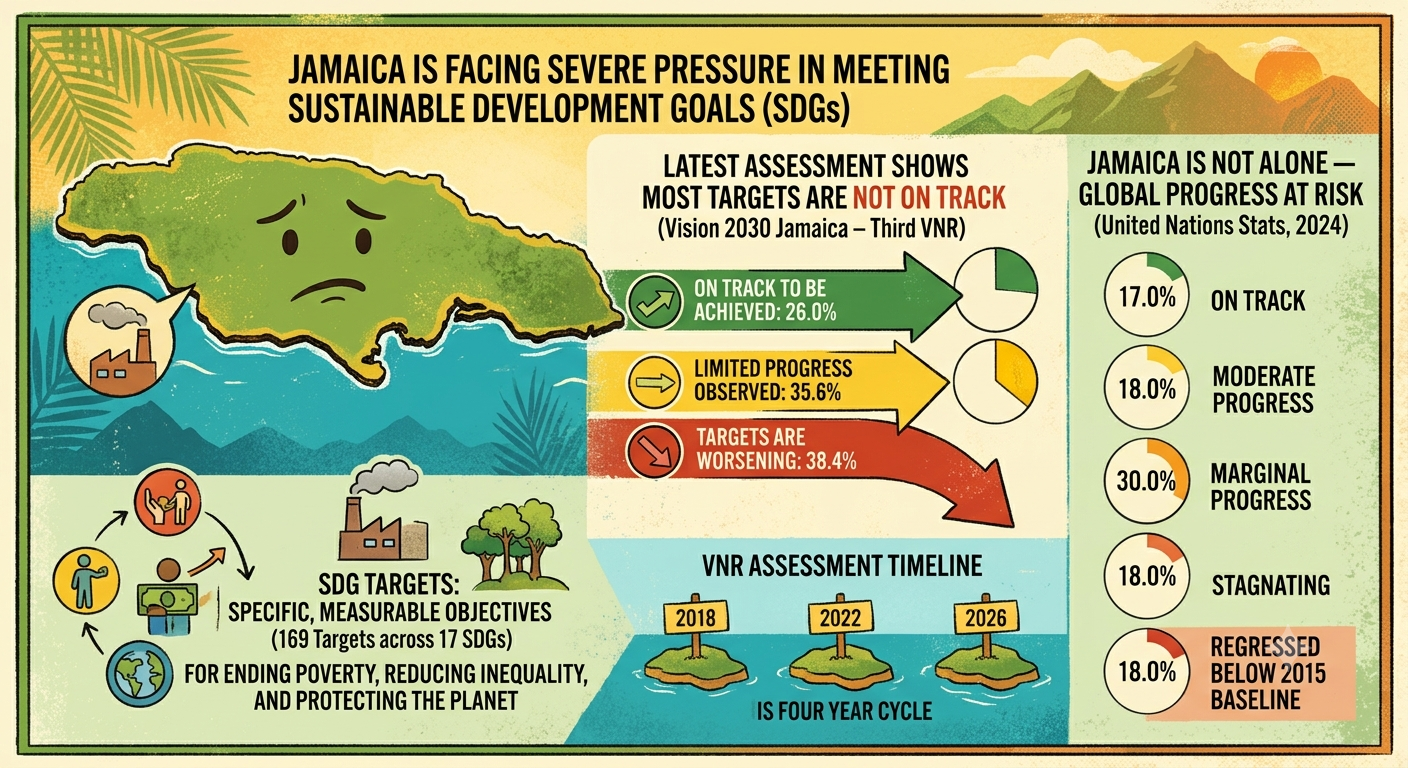
Jamaica failing in most SDG targets like its LAC counterparts
Our Today
Cops see more success in solving crimes
Jamaica Observer
The Business Report—July 3, 2026
PBC Jamaica (Video)Watch
Death before court JCF murder clear-up rate soars, but most accused killers never faced a judge
Jamaica Star