
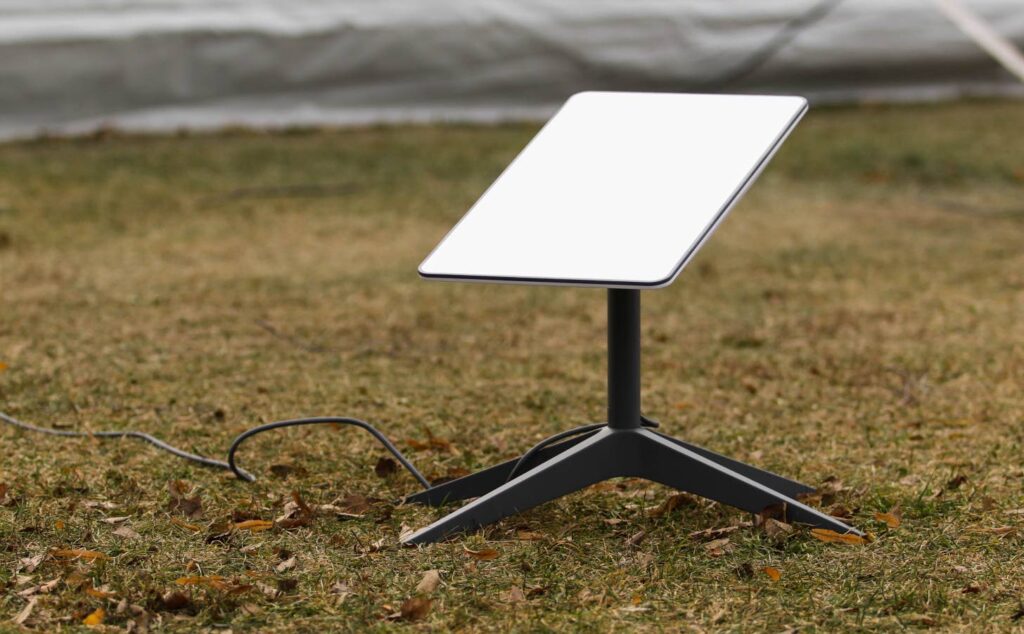
Director general for the Office of Disaster Preparedness and Emergency Management (ODPEM) Commander Alvin Gayle came under immediate challenge in Parliament last Wednesday after suggesting that demand for some Starlink devices had lessened as Hurricane Melissa recovery progressed.
Public Accounts Committee (PAC) Chairman Julian Robinson dismissed the explanation, arguing that many communities remained without reliable telecommunications for months after the hurricane as Members of Parliament questioned why 80 of the 200 devices procured by ODPEM had not been deployed.
The exchange unfolded during a meeting of Parliament’s PAC, which was examining the auditor general’s compliance audit into governance, procurement activities and the receipt and distribution of Starlink devices under the Hurricane Melissa relief initiative.
The audit found that while 200 Starlink devices, valued at $12.12 million, were procured by ODPEM, 80 remained in storage at the Office of the Commissioner of Police when auditors conducted their verification, while all 41 devices physically inspected at eight recipient entities were also found to be unused.
The issue was raised by Member of Parliament for St Mary South Eastern Christopher Brown, who questioned why nearly half of the devices remained unused.
“I noticed that, of the 200 Starlink, I read where, based on the auditor general’s audit, 80 remain unused… Is it that they are derelict? Is it that there is an issue with them because that is close to 50 per cent?” Brown said.
Responding, Gayle said the devices were not defective and suggested that operational requirements may have changed as the emergency response evolved.
“They are not derelict. It is more than 200 Starlink [devices] that were handed over to the Jamaica Constabulary Force. In terms of that 80 that you speak of, by way of context, we have had to understand that as we progressed in the initial response and sort of recovery phase, as well as perhaps that some of the requirements would have been lessened,” he told the committee.
However, Robinson immediately challenged that reasoning.
“I don’t think that could be the case, and again, there are members here from affected areas who would agree that absolutely couldn’t be the case… I mean, in some areas, they had no light, so they wouldn’t have telecom provision. So I would say at least for the first six to seven months after the hurricane, there would have absolutely been a need for these devices to be deployed, whether to a post office, police station, schools, et cetera. So that couldn’t be the reason why they weren’t deployed — not a lack of demand or a need.
“And, in fact, there are still some areas that, as of today, would still require devices outside of the very urban centres,” Robinson said.
The discussion then widened after Gayle disclosed that the 200 devices purchased by ODPEM represented only a portion of the Starlink units brought into the country after Hurricane Melissa.
He told MPs that “upwards of 700” Starlink devices had entered the national system through purchases and donations, prompting Brown to request a complete breakdown of how all of the devices had been allocated and deployed.
Permanent secretary in the Office of the Prime Minister, Ambassador Rocky Meade clarified that responsibility for the wider Starlink programme rested primarily with the ministry responsible for telecommunications, while ODPEM had only financed some of the devices through the National Disaster Fund.
Robinson, however, insisted that the committee wanted a full accounting.
He argued that without that information, the public would inevitably question why so many devices appeared to have remained idle while hurricane-hit communities struggled with disrupted communications.
Pressed about whether the remaining devices could be mobilised quickly if another major weather system threatened Jamaica this hurricane season, Gayle said ODPEM is exploring a “just-in-time” activation model instead of paying to keep all units active year-round.
He said the agency is in discussions with the service provider and the relevant ministry, explaining that maintaining continuous activation for every device would incur significant ongoing costs.
In the meantime, he said, ODPEM had reverted to activating the approximately 55 Starlink devices under its direct control on a monthly basis during the hurricane season.
The committee also revisited questions surrounding the procurement of the devices.
MP for Hanover Western Heatha Miller-Bennett asked Gayle to explain an apparent discrepancy between ODPEM’s response to the auditor general and the audit report regarding the source of funding for the Starlink purchase.
Gayle maintained that the $12.12 million spent on the devices did not represent a separate withdrawal from the National Disaster Fund but was financed from the $350 million previously approved by the financial secretary for Hurricane Melissa response activities.
Manchester Southern MP Peter Bunting, meanwhile, questioned why ODPEM had waited until after Hurricane Melissa struck to procure the devices instead of pre-positioning them as part of its disaster preparedness strategy.
Drawing on his own experience trying to source Starlink equipment immediately after the hurricane, Bunting said the move reflected “reactiveness” rather than preparedness.
“I thought that the whole raison d’etre for ODPEM was to anticipate and prepare for disasters,” he said.
Gayle acknowledged shortcomings in the approach.
“There were gaps, and I believe we have clearly identified those gaps, and steps are being taken to have those rectified,” he told MPs.
The auditor general’s report found broader weaknesses in the procurement and management of the Starlink programme, including that the purchase was initiated through ministerial instruction rather than by ODPEM’s director general, as required under the Public Procurement Act, procurement documentation was prepared only after the devices had been delivered, and the agency lacked adequate inventory records for the equipment. The report recommended a structured deployment and activation plan, improved inventory controls and procurement processes that comply fully with the law.
In its formal response to the audit, ODPEM accepted the recommendations and said it is developing a “just-in-time” activation plan to facilitate the rapid deployment and effective utilisation of the devices during future emergencies, while strengthening inventory management and procurement oversight.
Syndicated from Jamaica Observer · originally published .
Legal context · powered by Jurifi
Get the legal angle on this story. Pick a prompt and Jurifi's AI will explain it using Jamaican law.
AI replies are based on Jamaican law via Jurifi. Not legal advice.
Other coverage
Public Accounts Committee || July 22, 2026
PBC Jamaica (Video)Watch
National Disaster Fund Committee Now In Place – Commander Gayle
Jamaica Information Service
Parliament recess delays IC report
Jamaica Gleaner
507 Roofs Repaired Under Phase One of Gov’t Led ROOFS Repair Programme
Jamaica Information Service
ODPEM Taking Decisive Action to Strengthen Operations and Enhance Accountability
Jamaica Information Service