
Holness orders JCF public education drive on police-citizen encounters
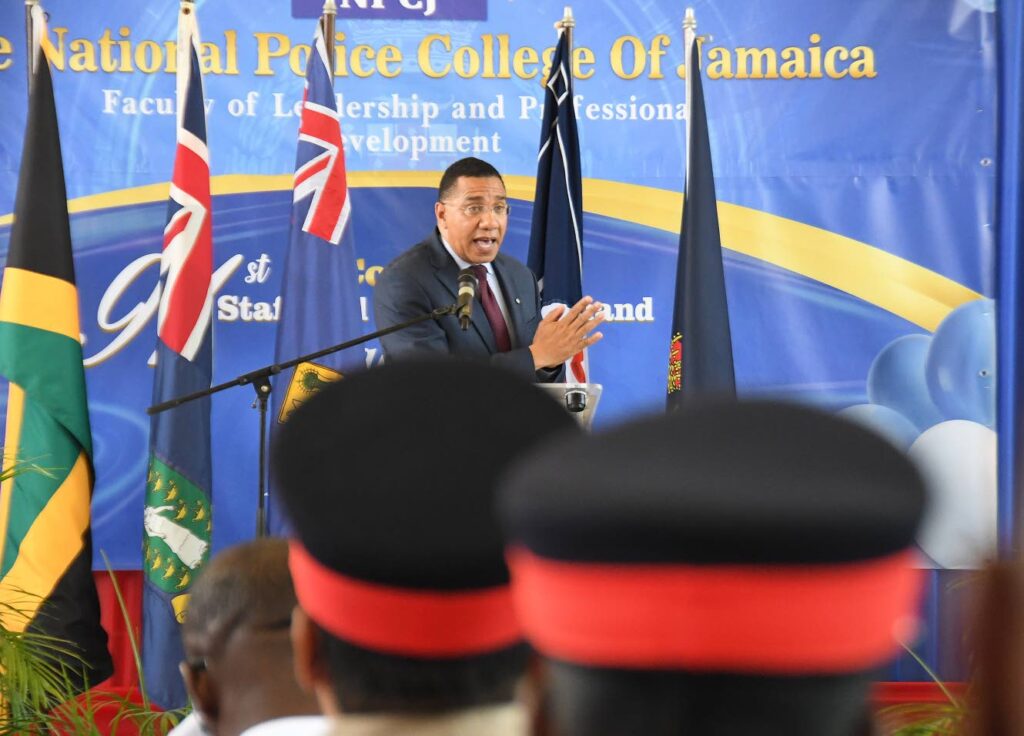
Prime Minister Dr Andrew Holness has instructed the Jamaica Constabulary Force to prepare and roll out a national public education programme aimed at improving how police and citizens deal with each other.
The directive comes as confrontations between cops and members of the public continue to surface, many of them recorded and posted on social media. Holness said the effort should promote lawful behaviour, restraint, and respect on both sides.
He was addressing the graduation ceremony for the 91st Staff & Junior Command Courses at the National Police College of Jamaica in Twickenham Park, St Catherine, last Friday.
According to Holness, the campaign may need to run for two to three years because of the number of police-public encounters that have turned hostile and damaged Jamaica’s image when circulated online.
“I have seen it so often. It is shared on social media. It makes the country look bad. Damaging to our image. It is now time that the JCF develops and deploys — along with other stakeholders — a national public education campaign,” Holness said.
“I don’t want to use the word teach but that’s what it comes down to — to educate our citizens about how they should interact with the police, and to educate the police as to how they should interact with the citizens,” he added.
The prime minister said some Jamaicans still view police power with suspicion because of the JCF’s colonial history. He noted that although the force has improved its professionalism and public standing, longstanding attitudes among both officers and civilians still have to be confronted.
“There is a culture, unfortunately, in our country [and] we don’t speak about it, because we have a sense of exceptionalism of ourselves. But the truth is, we resist authority,” Holness said, adding that some officers expect automatic respect because of the uniform while some citizens approach police encounters expecting oppression or injustice.
Holness said the proposed campaign should help the public understand the need to obey lawful police instructions, while also reinforcing that police personnel must remain professional when engaging citizens.
He referred to incidents he said had escalated without need, including complaints brought to him by members of the public. Among them, he said, was a woman who became fearful after being stopped while driving alone at night, as well as a traffic-stop complaint involving two young men and M16 rifles allegedly being pointed during the encounter.
The prime minister told the 35 graduates, who were senior officers or newly promoted members of the force, that they have a duty to identify colleagues who behave unprofessionally and recommend additional training or disciplinary measures where required.
“You must continue to maintain your tactical superiority. When gunmen see you they must get nervous and run. But when decent, law-abiding citizens see you they must say, ‘ah, these are the good guys, they are here to protect me’,” Holness said.
He said that expectation means officers must show greater intelligence, judgement, respect, and professionalism. Holness also said the National Security Council had considered the matter and that directives had been given to Commissioner of Police Dr Kevin Blake concerning the rollout of what he called the National Public Education Act.
Holness further argued that Jamaicans must recognise that resisting police is an offence. He urged people to comply with police instructions in the moment and make a formal complaint afterwards if they believe they were treated improperly.
“This cannot continue as we seek to modernise our society. There must be a watershed period where this ends. In the same way that we have been able to end political violence and we are now getting on top of murders, the police force must now lead in dealing with how we manage police-citizen interaction,” Holness said.
He also restated the Government’s intention to widen the JCF’s use of surveillance tools, including body cameras for officers, cameras in police vehicles, and broader closed-circuit television coverage islandwide.
Syndicated from Jamaica Observer · originally published .
Legal context · powered by Jurifi
Get the legal angle on this story. Pick a prompt and Jurifi's AI will explain it using Jamaican law.
AI replies are based on Jamaican law via Jurifi. Not legal advice.
Other coverage
Force4Good Podcast: Season 2: EP 2 - Inside the Strategic Operations Portfolio
JCF — Jamaica Constabulary Force (Video)Watch
US resident shot dead at Sangster airport | Two men wanted in Jamaican deported from St Kitts /JBNN
JBN Network (Video)Watch
Prison Call Exposes Serious Security Gaps in Jamaica System
Realnews YtWatch
St Elizabeth cops wearing body cameras in commercial centres
Jamaica Gleaner
Jamaica News Today: Latest Updates For May 25, 2026 | RNM TV
Realnews YtWatch