UHWI Could Have Averted Half of Revenue Losses With Proper Controls, Says Mitchell-Led Review
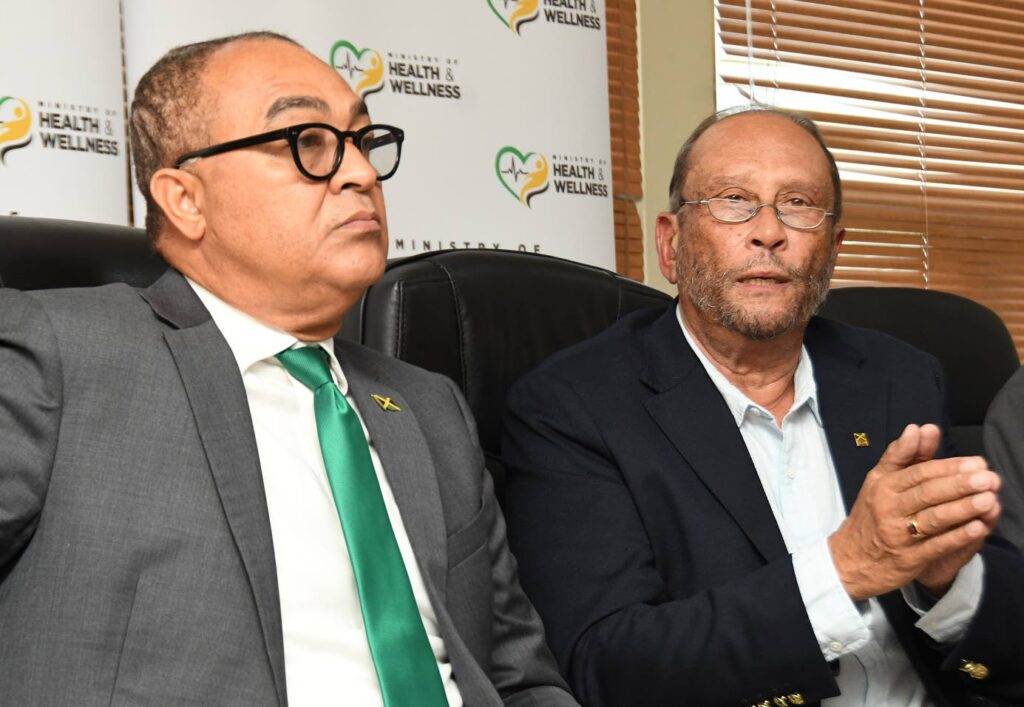
More than half of the revenue losses recorded at the University Hospital of the West Indies (UHWI) could have been prevented if administrators had adhered to established procurement and financial management standards. That is among the central conclusions of an Institutional Review Committee, chaired by veteran attorney-at-law Howard Mitchell, which was set up by Minister of Health and Wellness Dr Christopher Tufton to probe operational shortcomings flagged in a recent auditor general's report on the hospital.
The committee outlined a worrying account of how prolonged lapses in financial discipline, inventory tracking, procurement processes and governance have not only weakened the institution's finances but also disrupted clinical services at Jamaica's flagship teaching hospital.
At a press briefing on Tuesday where the findings were unveiled, Mitchell said the hospital's financial troubles were rooted less in inadequate funding than in a recurring failure to comply with basic governance and operational protocols.
"I'm speaking personally… but from my experience and my involvement with government functions and functionaries, if they followed the procurement rules, if they followed the financial reporting rules, if they followed standard practises, good standard practises of inventory management, certainly more than 50 per cent of the revenue loss would have been covered," Mitchell said.
"That's my estimation, because part of the reason why they don't get their budget the way they want to get it is because they don't have the reporting. So how are you going to keep giving somebody money if you don't know what to do with the money?" he added.
Mitchell stressed that the erosion of internal systems and accountability at UHWI has had real-world implications for Jamaicans who depend on the institution for treatment.
"A good part of the reason why the hospital cannot function effectively is because sometimes they don't have the medications, the bandages, because of poor inventory control, and the procurement of goods and services has been murky, to say the least," he said.
He noted that fragile inventory systems and lax supervision can leave essential medical supplies missing when patients need them, even after funds have been disbursed.
"If you do not have processes that deal with inventory control, with the control of your drugs, your medication, your plasters, your bandages and it is a free for all and you have no system of recording who gets what, you will end up with a situation where one day you go to the storeroom and there is no bandage, there are no pills. You will end up with parties external to the hospital having medical inventory better than the hospital which belongs to the hospital," Mitchell said.
The committee also tied procurement breakdowns to weakened patient services, arguing that overspending and poor compliance siphon resources away from clinical care.
"Similarly, with things that have to do with procurement, we have encountered situations in the hospital where, because procurement rules weren't followed and a simple thing like three bids or offers being taken, you ended up paying three times the value of equipment. That impacts on your patient care and your patient delivery, because if you are going to spend money on this microphone that is more than a microphone is worth, you are not going to be able to spend it on the human life that you are empowered to take care of," he said.
The review also flagged the hospital's heavy tax exposure as another threat to its viability, observing that UHWI is carrying roughly $40 billion in taxes, penalties and interest, while piling up about $300 million in fresh liabilities every month.
Mitchell described the position as unsustainable, cautioning that even with relief on penalties and interest, the hospital would still owe billions. He warned that the combination of weak governance, fragile financial oversight and operational missteps had driven UHWI to a breaking point that demands swift corrective action.
"As a consequence, the University Hospital is in critical state. It, itself, is in the ICU," Mitchell said in summing up the gravity of the institution's predicament.
For his part, Tufton offered context for the financial pressures, pointing out that UHWI's status as the country's principal referral and teaching hospital often saddles it with costs that cannot always be recouped.
"The gaps between revenues and expenditure or cost is an ongoing gap, and I do agree that part of that lies within the inefficiencies of management, which is why we're trying to correct some of those issues, but part of it lies also in the mandate of the institution, in terms of collections, in terms of serving clients that are either not able to afford," Tufton said.
The minister conceded that the Government itself contributes to the hospital's mounting receivables by referring patients for care without firm payment arrangements in place.
"Every week I send people to the University Hospital and, to be totally frank, I am probably part of the cause of some of the delinquency, because the people that I send there for lifesaving treatment, if the ministry don't pay, there's no way that they're going to pay. But lives are at stake, and I cannot, with good intentions and with conviction, tell people that they can't go to the premier institution if they have an issue that requires a consultant that is not existing elsewhere," Tufton added.
Syndicated from Jamaica Observer · originally published .
Legal context · powered by Jurifi
Get the legal angle on this story. Pick a prompt and Jurifi's AI will explain it using Jamaican law.
AI replies are based on Jamaican law via Jurifi. Not legal advice.