
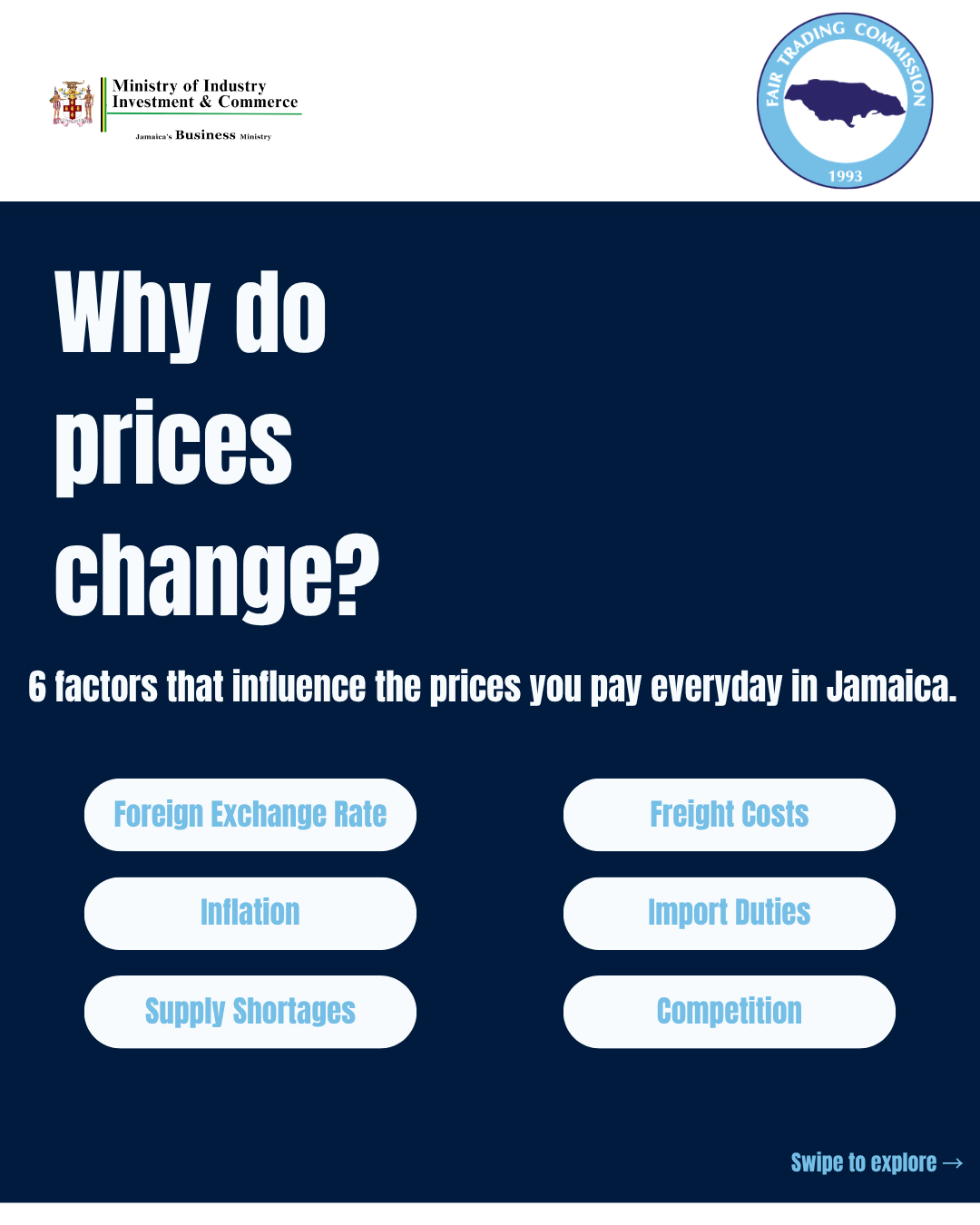
Why Do Prices Change?
Why Prices Change: Understanding the Forces Behind the Cost of Living in Jamaica By Shavanne Smith | Research Officer Few issues affect Jamaicans more directly than the price of everyday goods and services. Whether purchasing groceries, fuel ling a vehicle , buying medication, paying utility bills, or undertaking home repairs, consumers encounter prices every day. When those prices rise, the impact is felt immediately in household budgets and family finances. It is therefore understandable that many consumers become frustrated when the cost of living increases. Yet one of the most common misconceptions is the belief that every price increase is caused by greed, unfair business practices, or deliberate exploitation. While anti - competitive conduct can sometimes contribute to higher prices, the reality is that price s are influenced by a complex combination of global and domestic economic forces. For a small island economy like Jamaica, understanding why prices change is important . An informed consumer is better equipped to make sound purchasing decisions, identify suspicious market behaviour, and distinguish legitimate price increases from conduct that may warrant regulatory attention. Jamaica's Economic Reality Jamaica is what economists describe as a small, open, import - dependent economy. Simply put, the country imports much of what it consumes. Fuel, pharmaceuticals, machinery, electronics, construction materials, and a significant portion of food products are sourced from
overseas markets. Even many goods manufactured locally rely on imported raw materials and inputs. This means that events occurring thousands of miles away can have a direct impact on the prices paid by consumers in Jamaica . A drought affecting agricultural production in South America, a conflict in the Middle East, a disruption at a major shipping port in the United States, or a shift in global financial markets can all eventually influence the price of goods on Jamaican shel ves. The price a consumer pays is therefore often the final result of a long chain of economic events stretching across multiple countries and industries. The Exchange Rate: Why the Value of the Jamaican Dollar Matters One of the most important factors affecting prices in Jamaica is the foreign exchange rate. Because most international trade is conducted in United States dollars, Jamaican importers must purchase foreign currency when they buy goods from overseas suppliers. When the Jamaican dollar loses value against the US dollar, importers require more Jamaican dollars to purchase the same amount of foreign currency. The consequences are straightforward. If a business imported a product for US$100 when the exchange rate was J$150 to US$1, the cost would be J$15,000. If the exchange rate later moved to J$160 to US$1, the same product would now cost J$16,000 before any local mark - ups or taxes are applied. Businesses facing higher import costs often pass those increases on to consumers. As a result, exchange rate movements can affect the prices of everything from groceries and gasoline to motor vehicles and household appliances. Because Jamaica imports such a large share of what it consumes, even relatively small movements in the exchange rate can have noticeable effects on the cost of living.
Shipping Costs: The Price of Being an Island Living on an island offers many advantages, but it also comes with economic costs. Virtually every imported product must be transported to Jamaica by sea or air. Those transportation costs form part of the final price consumers pay. Global shipping markets can be highly volatile. When demand for shipping services rises or disruptions reduce available shipping capacity, freight rates increase. Businesses importing goods must absorb those higher transportation costs, which are eventuall y reflected in retail p rices. The COVID - 19 pandemic demonstrated how vulnerable global supply chains can be. Manufacturing disruptions, port congestion, container shortages, and transportation bottlenecks caused freight rates to surge worldwide. Consumers in Jamaica experienced the eff ects through higher prices across a wide range of products. More recently, geopolitical conflicts have disrupted important shipping routes and increased fuel costs, once again placing upward pressure on transportation expenses. For an island economy that depends heavily on imported goods, rising freight costs can have a significant impact on household budgets. Inflation: When Prices Rise Across the Economy Another important driver of price increases is inflation. Inflation refers to a sustained increase in the general level of prices throughout the economy. Unlike a one - time increase in the price of a specific product, inflation occurs when many goods and services become more expensive over time. There are several forms of inflation that affect Jamaica. Imported inflation occurs when global prices for commodities such as food, fuel, fertiliser, or manufactured goods increase. Since Jamaica imports many of these products, international price increases often flow directly into local markets.
Cost - push inflation arises when businesses face higher production costs. Rising energy prices, transportation expenses, wages, or financing costs can all contribute to higher prices for consumers. Demand - pull inflation occurs when consumer demand grows faster than the supply of goods and services. As more people compete for limited products, prices tend to rise. Regardless of its source, inflation reduces purchasing power. In practical terms, the same amount of money buys fewer goods and services than before. This is particularly challenging for lower - income households, which spend a larger proportion of their income on essential items such as food, transportation, and utilities. Tariffs and Taxes: The Government's Role in Pricing G overnment - imposed charges contribute to the final cost of imported goods. Before imported products reach store shelves, they may be subject to customs duties, General Consumption Tax (GCT), environmental levies, customs fees, and other charges. These costs are typically calculated based on the value of the goods, including the cost of shipping and insurance. Consequently, when the price of an imported product rises, the taxes applied to that product often increase as well. Tariffs serve several policy objectives. They generate government revenue and can provide protection for local industries competing against foreign producers. However, tariffs also raise the prices consumers pay for imported goods. Policymakers therefore face the difficult challenge of balancing support for domestic industries with the goal of maintaining affordable prices for consumers.
Supply Shortages: When Demand Exceeds Availability Prices are also influenced by one of the most fundamental principles in economics: supply and demand. When the supply of a product falls while demand remains unchanged, prices typically rise. Jamaica has experienced this reality on numerous occasions. Natural disasters such as hurricanes can damage crops, disrupt transportation networks, and reduce the availability of essential goods. Global events can have similar effects. Conflicts, droughts, pandemics, and production disruptions can all create shorta ges in international markets. During shortages , higher prices often emerge naturally as consumers compete for limited supplies. In many cases, these price increases are a normal market response. Higher prices signal producers and suppliers to increase production and bring additional supply to the market. However, shortages can also create opportunities for anti - competitive conduct, particularly if businesses coordinate price increases or exploit dominant market positions. This is where competition authorities become especially vigilant. Competition: The Force That Keeps Prices Honest While many factors affecting prices originate outside Jamaica, competition remains one of the most important domestic influences on what consumers ultimately pay. Competition occurs when businesses actively compete for customers by offering better prices, higher quality products, and improved service. When several businesses compete vigorously, consumers benefit. Companies must continually improve their offerings to attract customers, often reducing prices. When competition is weak, however, prices often ri se. Markets dominated by a few firms may become vulnerable to anti - competitive behaviour, including price fixing, market allocation, abuse of dominance, and other practices that reduce consumer choice and increase costs. Competition is therefore not simply an abstract economic
concept. It is one of the most effective mechanisms for protecting consumers and promoting economic efficiency. Every dollar saved because businesses are competing vigorously represents a direct benefit to consumers. Not Every Price Increase Is Evidence of Wrongdoing One of the most important lessons consumers can learn is that not every price increase indicates anti - competitive conduct. A rise in fuel prices may reflect higher global oil prices. Increased grocery prices may result from exchange rate movements, shipping costs, supply shortages, or inflationary pressures. Construction materials may become more expensive because of higher fr eight charges or disruptions in global supply chains. At the same time, consumers should remain alert to warning signs that may sugge st anti - competitive behaviour. If competing businesses raise prices simultaneously without any apparent justification, if a dominant firm imposes excessive price increases unrelated to costs, or if market conditions suggest collusion among competitors, these situations may warrant close r scrutiny. Understanding the difference between legitimate market forces and anti - competitive conduct is essential for effective consumer protection. Knowledge Is Consumer Power Prices are more than numbers on store shelves. They are signals that reflect economic conditions, production costs, scarcity, demand, government policy, and the level of competition within a market. For Jamaicans navigating an increasingly complex global economy, understanding these forces is more important than ever. The exchange rate, shipping costs, inflation, tariffs, supply shortages, and competition all interact to shape the prices consumers pay every day. No single factor explains every increase, and there is rarely a simple explanation for rising costs.
However, consumers who understand how markets work are better positioned to make informed decisions, protect their purchasing power, and identify behaviour that may undermine competition. In the end, informed consumers are empowered consumers. And in a competitive marketplace, consumer knowledge remains one of the strongest forces for accountability, fairness, and economic progress. July 2026
Source: Original PDF
Syndicated from Jftc · originally published .
Legal context · powered by Jurifi
Get the legal angle on this story. Pick a prompt and Jurifi's AI will explain it using Jamaican law.
AI replies are based on Jamaican law via Jurifi. Not legal advice.
Other coverage

Christopher Burgess | Jamaica’s no-competition, no-growth economy
Jamaica Gleaner
Speaking Notes: Review of Economic Performance, January–March 2026
Planning Institute of Jamaica
Bulb blues - The seasonal reality behind Jamaica’s onion price spike
Jamaica Gleaner
Global oil demand dropping, but US drivers keep buying more gas
Jamaica Gleaner
Yaneek Page | The missing scorecard: Jamaica needs a national electricity affordability target
Jamaica Gleaner