Questions mount over J$770 million left unused in Jamaican gov’t aid program
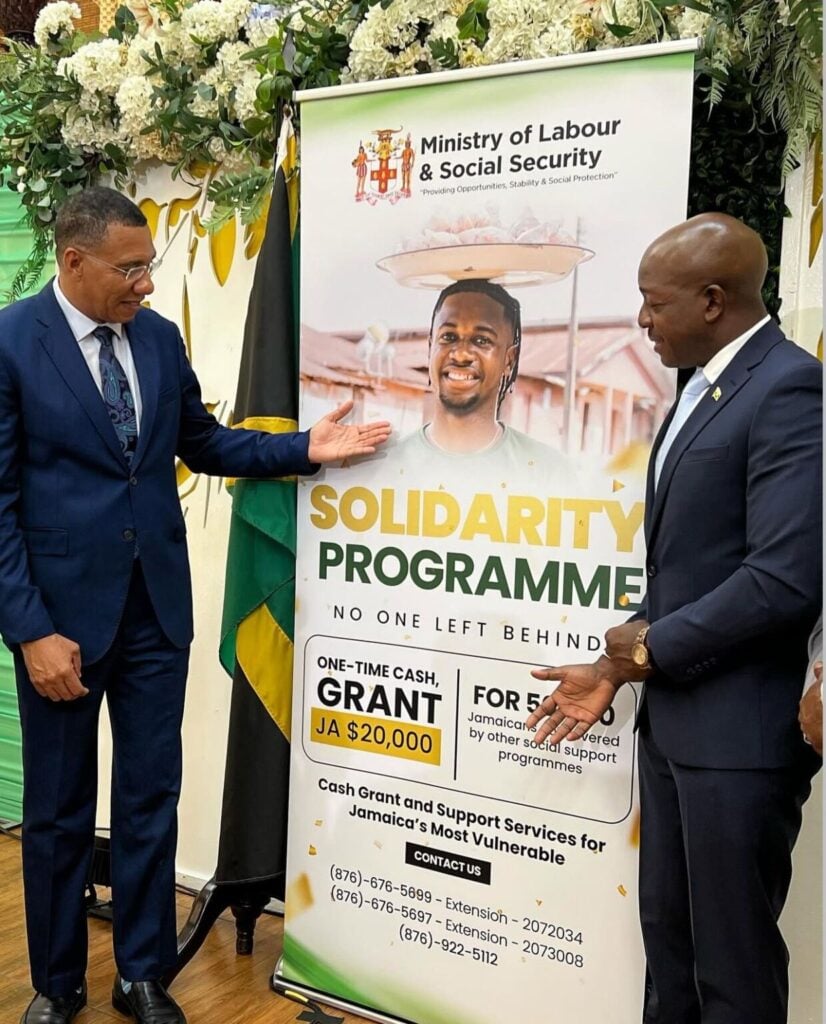
Jamaican government lawmakers and Opposition members on Wednesday raised alarm after learning that hundreds of millions of dollars allocated to assist vulnerable Jamaicans under the Government’s Solidarity Programme had gone largely unused and were ultimately returned for debt reduction.
The issue emerged during a meeting of Parliament’s Public Administration and Appropriations Committee (PAAC), where acting permanent secretary in the Ministry of Labour and Social Security, Dione Jennings, revealed that only about JMD$230.42 million of the programme’s JMD$1-billion allocation had been disbursed.
The programme, introduced in June 2025 as a social intervention initiative, was intended to provide one-time grants of $20,000 to 50,000 Jamaicans considered economically vulnerable, including elderly citizens, low-income informal workers, persons with disabilities, and unemployed young adults not enrolled in school or training programmes.

According to Jennings, the ministry received more than 18,000 applications, of which 11,521 were approved for payment.
Her disclosure means that approximately $769.58 million — more than three-quarters of the programme’s allocation — remained unspent.
“We are at the end of the financial year, so the money unspent would have been returned for debt reduction,” Jennings told the committee when questioned about the unused balance.

Reactions from members of the Opposition
The explanation triggered immediate concern among committee members, who argued that many Jamaicans continue to struggle financially and had expected relief through the programme.
Member of Parliament for St Catherine South Eastern Dr Alfred Dawes said the revelation pointed to fundamental problems in the programme’s design and implementation.
“We’re just coming from, we’re still reeling from the revelation that there’s $1.4 billion of donor aid barely spent, and now we are being informed that there is $770 million unspent, earmarked for the most vulnerable in our society. Something about the conceptualisation of this programme was wrong from the outset,” Dawes said.

He argued that vulnerable people were still not being reached despite the sizeable allocation.
“If people are suffering and we are sitting on $770 million dollars that just went back into the Consolidated Fund or for debt payments, something has to be done about this programme. It’s clearly not working. The persons who it is meant to help, they’re not receiving the help, and the money is just sitting there,” he added.
PAAC Chairman Peter Bunting also questioned the programme’s eligibility rules, saying many applicants who sought assistance through constituency registration drives later discovered they did not qualify.
“The response was overwhelming, but it turned out that many persons who showed up didn’t understand the criteria. For example, there were a number of persons, [for example] students who were attending tertiary institutions, and that was a disqualification,” Bunting said.
Bunting suggested the Government should have relaxed some of the requirements given the large amount of money left unused.
“Maybe the criteria could have been loosened somewhat to allow the full use of the $1 billion, because people who were genuinely in need — you know, even to continue in tertiary education — seem to have been disqualified just by virtue of the fact that they were enrolled at a tertiary institution,” he argued.
Jennings defended the framework of the programme, saying it was specifically designed to reach persons who were not already benefiting from existing State assistance.
“That’s why we didn’t broaden it to include some of these groups that you’re making mention of, because we’re trying to reach those who would normally not be considered for the programmes,” she said.
She explained that applicants already receiving benefits through programmes such as the Programme of Advancement Through Health and Education (PATH), the National Insurance Scheme, or the Social Pension Programme were excluded from the Solidarity Programme.
Jennings also told the committee that several applicants were referred to other agencies for support. These included 90 people directed to the Registrar General’s Department because of birth certificate issues, more than 9,800 low-income informal workers referred to HEART/NSTA Trust and labour market systems, and medically vulnerable applicants referred to specialised agencies.
She noted that some approved beneficiaries had still not collected their grants and said the payment period had been extended to June 30, 2026.
The latest disclosure comes amid growing scrutiny over the pace of Government spending on social and disaster relief programmes.
Earlier this month, the Auditor General’s Department reported that only $26.2 million of the JMD$1.44 billion donated for Hurricane Melissa recovery efforts had been spent by February 23, 2026.
Auditor General Pamela Monroe Ellis said weaknesses in financial oversight and accountability had limited transparency in the use of the disaster recovery funds.
“This audit found that weaknesses in financial management, governance, and programme accountability limited transparency over Hurricane Melissa relief resources,” Monroe Ellis said.
“Of $1.44 billion in cash donations received, only $26.2 million (1.8 per cent) had been spent as at February 23, 2026, alongside unreported and unspent Hurricane Beryl balances,” she added.
Syndicated from Cnweekly · originally published .
Legal context · powered by Jurifi
Get the legal angle on this story. Pick a prompt and Jurifi's AI will explain it using Jamaican law.
AI replies are based on Jamaican law via Jurifi. Not legal advice.